7.1.2 分词与 Tokenizer
学完要能做到
读完这一节,你应该能看着任意一段 prompt,回答四个实操问题:
- 这段文字会被切成哪些 tokens?
- 模型实际收到哪些整数 ID?
- 哪些位置是真内容,哪些位置只是 padding?
- 这段 prompt 会不会浪费或超出上下文窗口?
先建立心智模型
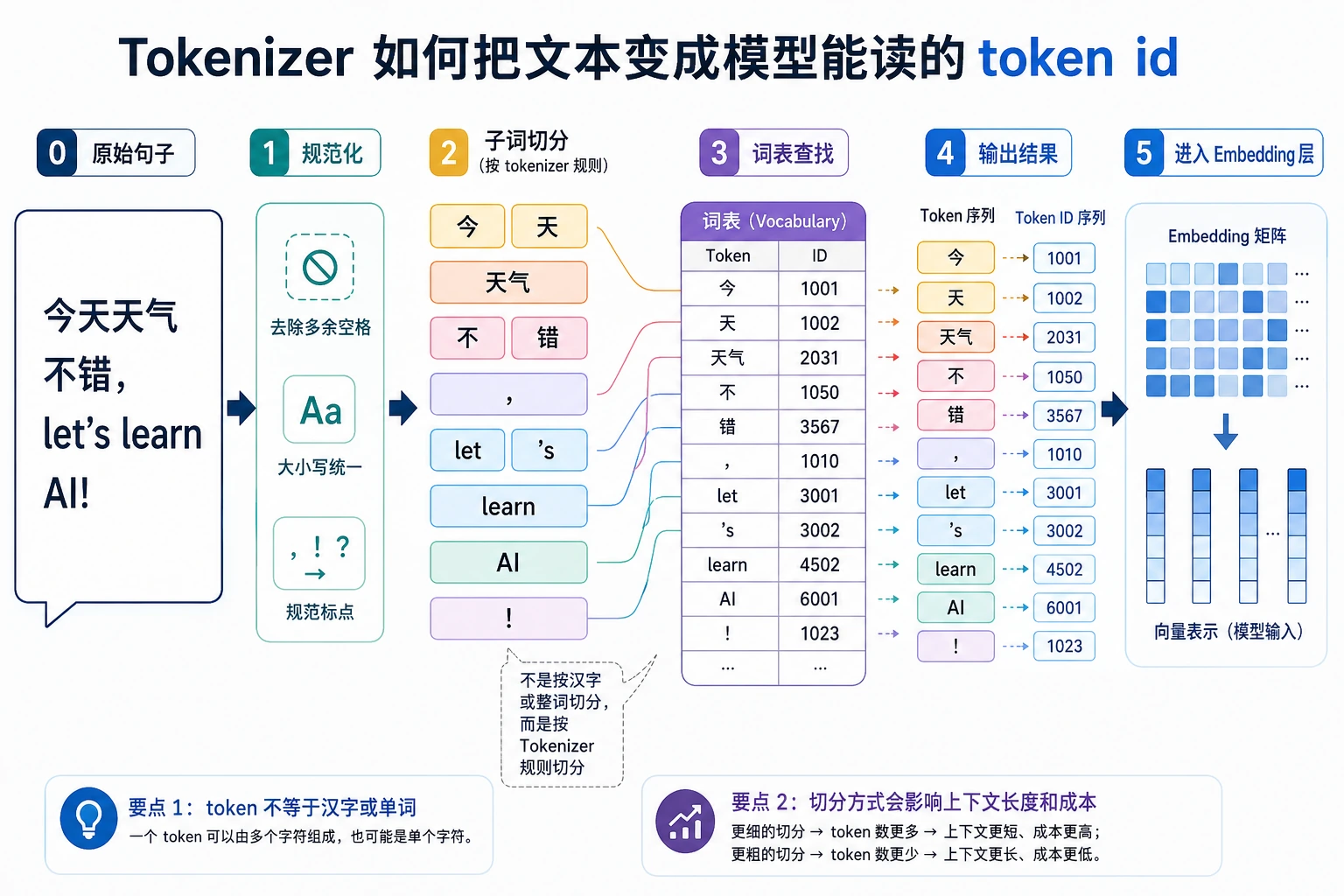
神经网络不能直接读字符串,它接收的是张量。Tokenizer 是人类文字和模型张量之间的契约:
raw text -> tokens -> input_ids -> model
很多看起来很玄的大模型问题,只要检查这个契约就会变清楚:
- 一个词可能被拆成多个 token;
- 标点、大小写、中文、代码、emoji 都可能显著改变 token 数;
- padding 让同一批样本长度一致;
- truncation 会在序列过长时静默删掉内容;
- chat template 会在 system、user、assistant 消息周围加入隐藏结构 token。
切分粒度的取舍
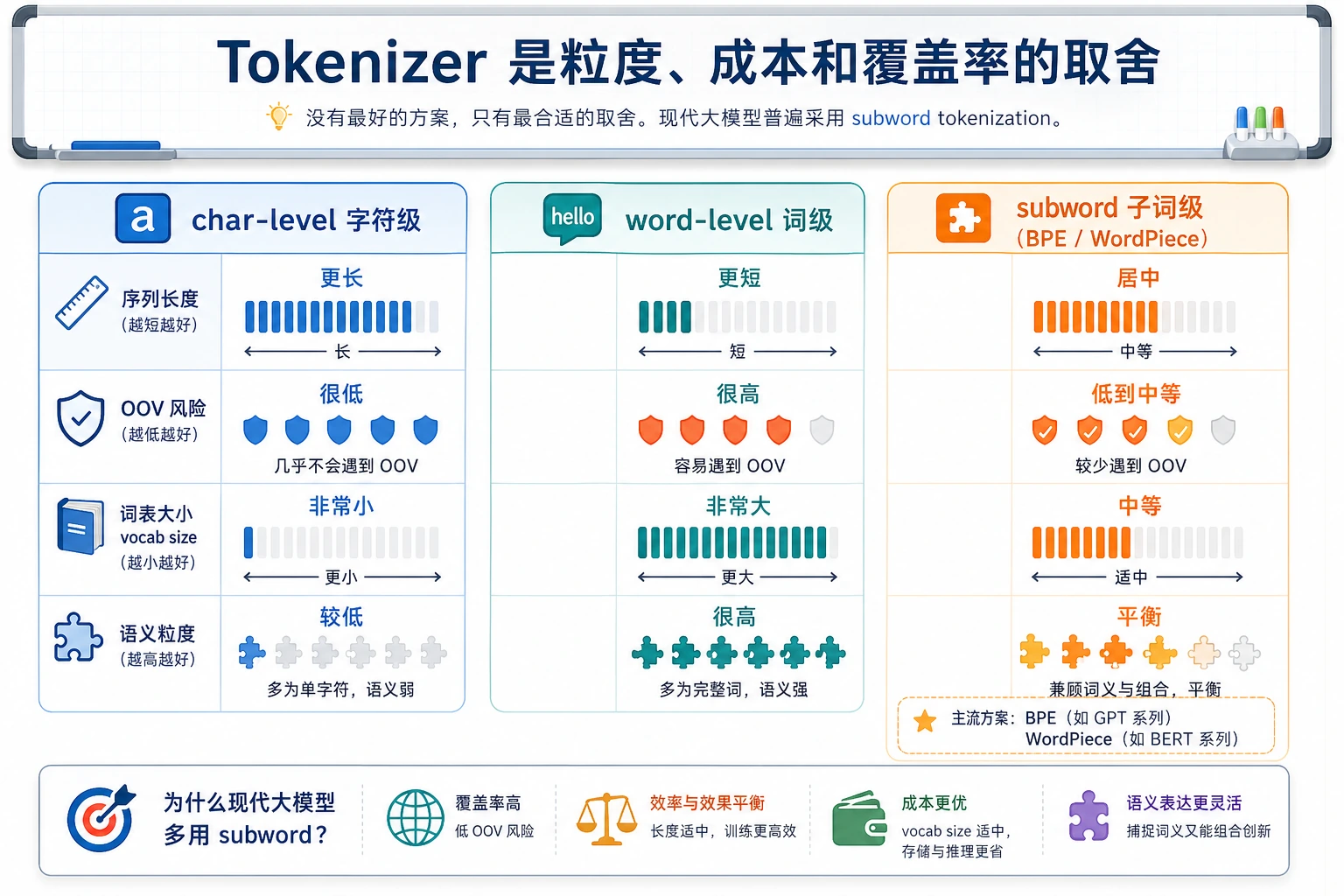
常见切法有三类:
| 方法 | 例子 | 优点 | 缺点 |
|---|---|---|---|
| 字符级 | r e f u n d | 几乎没有未知词 | 序列很长 |
| 词级 | refund policy | 语义直观 | 很多词会超出词表 |
| 子词级 | token ##ization | 工程上更平衡 | 肉眼不如整词好读 |
现代 LLM 通常使用子词分词。BPE、WordPiece、SentencePiece 是从语料中学习可复用片段的不同方法。核心思想一致:高频片段有稳定 ID,低频新词也能由更小片段组合出来。
实验 1:手写一个极小 WordPiece 风格 Tokenizer
先跑这个版本。它足够小,可以逐行看懂,但包含真实模型 API 里会出现的关键对象。
import re

VOCAB = {
    "[PAD]": 0,
    "[UNK]": 1,
    "[CLS]": 2,
    "[SEP]": 3,
    "refund": 4,
    "policy": 5,
    "reset": 6,
    "password": 7,
    "transform": 8,
    "##er": 9,
    "##s": 10,
    "token": 11,
    "##ization": 12,
    "please": 13,
    "help": 14,
    "need": 15,
    "evidence": 16,
}


def words(text):
    return re.findall(r"[A-Za-z]+", text.lower())


def split_wordpiece(word):
    if word in VOCAB:
        return [word]

    pieces = []
    start = 0
    while start < len(word):
        match = None
        for end in range(len(word), start, -1):
            piece = word[start:end] if start == 0 else "##" + word[start:end]
            if piece in VOCAB:
                match = piece
                break
        if match is None:
            return ["[UNK]"]
        pieces.append(match)
        start = end
    return pieces


def encode(text, max_length=10):
    tokens = ["[CLS]"]
    for word in words(text):
        tokens.extend(split_wordpiece(word))
    tokens.append("[SEP]")

    original_len = len(tokens)
    if len(tokens) > max_length:
        tokens = tokens[:max_length]
        tokens[-1] = "[SEP]"

    input_ids = [VOCAB.get(token, VOCAB["[UNK]"]) for token in tokens]
    attention_mask = [1] * len(input_ids)

    while len(input_ids) < max_length:
        tokens.append("[PAD]")
        input_ids.append(VOCAB["[PAD]"])
        attention_mask.append(0)

    return {
        "text": text,
        "original_len": original_len,
        "tokens": tokens,
        "input_ids": input_ids,
        "attention_mask": attention_mask,
    }


for example in [
    "Please help reset password",
    "Transformers refund policy",
    "Tokenization needs evidence",
]:
    row = encode(example, max_length=10)
    print("-" * 64)
    print("text:", row["text"])
    print("original_len:", row["original_len"])
    print("tokens:", row["tokens"])
    print("input_ids:", row["input_ids"])
    print("attention_mask:", row["attention_mask"])
预期输出:
----------------------------------------------------------------
text: Please help reset password
original_len: 6
tokens: ['[CLS]', 'please', 'help', 'reset', 'password', '[SEP]', '[PAD]', '[PAD]', '[PAD]', '[PAD]']
input_ids: [2, 13, 14, 6, 7, 3, 0, 0, 0, 0]
attention_mask: [1, 1, 1, 1, 1, 1, 0, 0, 0, 0]
----------------------------------------------------------------
text: Transformers refund policy
original_len: 7
tokens: ['[CLS]', 'transform', '##er', '##s', 'refund', 'policy', '[SEP]', '[PAD]', '[PAD]', '[PAD]']
input_ids: [2, 8, 9, 10, 4, 5, 3, 0, 0, 0]
attention_mask: [1, 1, 1, 1, 1, 1, 1, 0, 0, 0]
----------------------------------------------------------------
text: Tokenization needs evidence
original_len: 7
tokens: ['[CLS]', 'token', '##ization', 'need', '##s', 'evidence', '[SEP]', '[PAD]', '[PAD]', '[PAD]']
input_ids: [2, 11, 12, 15, 10, 16, 3, 0, 0, 0]
attention_mask: [1, 1, 1, 1, 1, 1, 1, 0, 0, 0]
这样读输出:
[CLS]和[SEP]是结构 token;transformers被拆成transform、##er、##s,因为词表里没有完整单词;input_ids是模型真正接收的整数;attention_mask=0标记[PAD]位置,提醒模型忽略它们。
实验 2:把 truncation 当成产品风险看
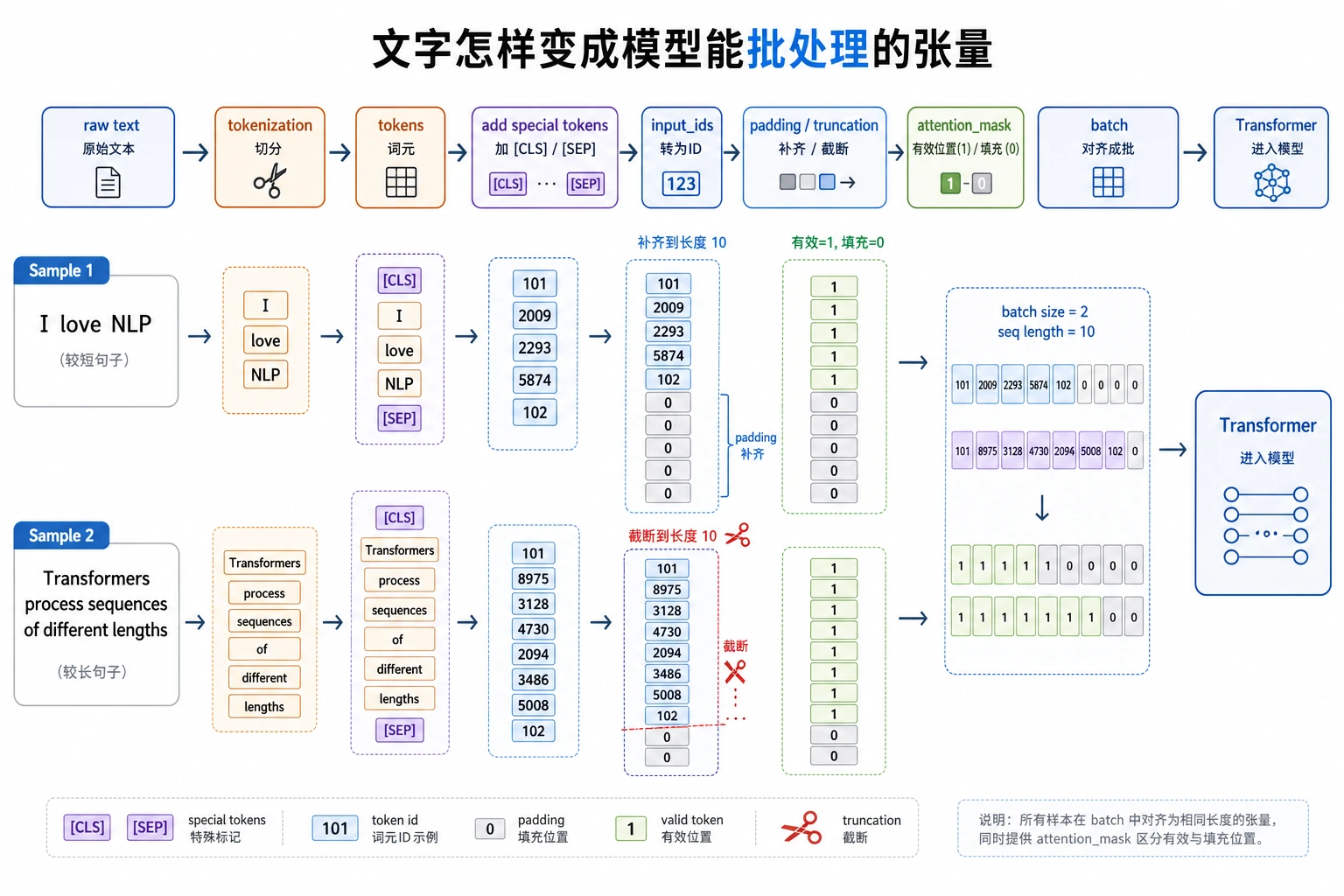
现在故意把上下文窗口调小。
row = encode("Please help reset password refund policy evidence", max_length=6)
print("original_len:", row["original_len"])
print("tokens:", row["tokens"])
print("input_ids:", row["input_ids"])
print("attention_mask:", row["attention_mask"])
预期输出:
original_len: 9
tokens: ['[CLS]', 'please', 'help', 'reset', 'password', '[SEP]']
input_ids: [2, 13, 14, 6, 7, 3]
attention_mask: [1, 1, 1, 1, 1, 1]
refund policy evidence 不见了。在真实客服助手里,这可能正好删掉用户真正想问的内容。所以 tokenizer 不是小小的预处理细节,它会影响成本、检索片段长度、prompt 设计和失败模式。
实验 3:检查真实 Hugging Face Tokenizer
第一次下载模型 tokenizer 时需要网络。
python -m pip install "transformers>=4.0" torch
from transformers import AutoTokenizer

tokenizer = AutoTokenizer.from_pretrained("bert-base-uncased")

batch = tokenizer(
    ["Please help reset password", "Tokenization needs evidence"],
    padding="max_length",
    truncation=True,
    max_length=10,
    return_tensors="pt",
)

print(batch.keys())
print(batch["input_ids"].shape)
print(tokenizer.convert_ids_to_tokens(batch["input_ids"][1]))
print(batch["attention_mask"][1].tolist())
预期形状级输出:
dict_keys(['input_ids', 'token_type_ids', 'attention_mask'])
torch.Size([2, 10])
['[CLS]', 'token', '##ization', 'needs', 'evidence', '[SEP]', '[PAD]', '[PAD]', '[PAD]', '[PAD]']
[1, 1, 1, 1, 1, 1, 0, 0, 0, 0]
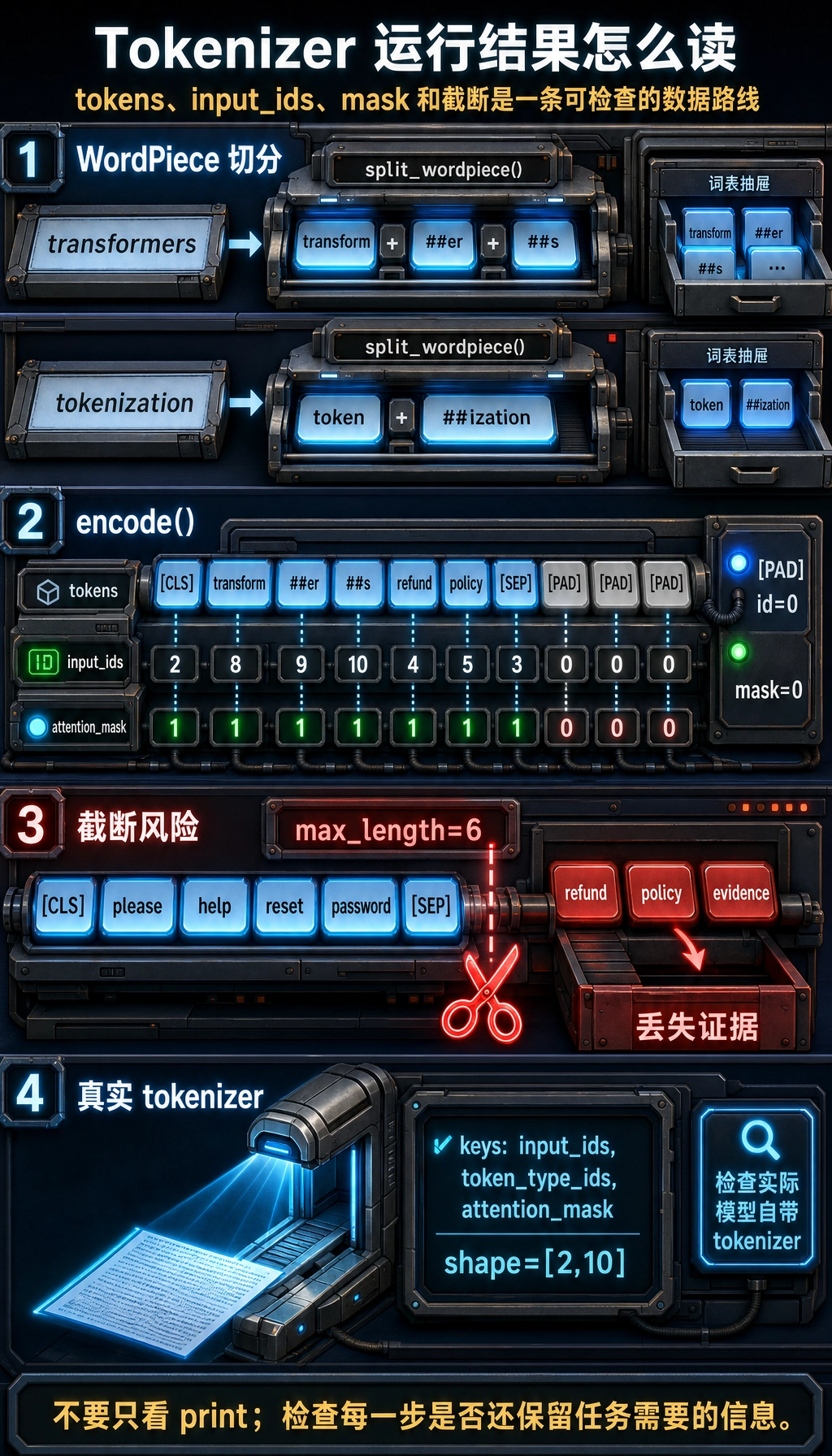
不同 tokenizer 的具体切法可能不同。这正是重点:永远检查你实际使用的模型自带 tokenizer。
值得记住的术语
| 术语 | 实操含义 |
|---|---|
vocab | tokenizer 训练得到的 token 到 ID 字典 |
| OOV | out-of-vocabulary,超出词表;通常用 [UNK] 或子词组合处理 |
| BPE | 把高频字符对合并成可复用子词 |
| WordPiece | 类似的子词思想,常见于 BERT 类 tokenizer |
| SentencePiece | 把文本当成原始字符流处理,适合多语言和无空格语言 |
padding_side | padding 加在左边还是右边;某些 decoder 模型很敏感 |
| context length | 输入和生成输出共享的最大 token 预算 |
| chat template | tokenizer 层面的对话格式,会加入角色和边界 token |
排查清单
Prompt 表现异常时,先检查 tokenizer,再怀疑模型:
- 打印完整 prompt 的 tokens 和 token IDs;
- 统计 chat template 之后的 token 数,不只看原始用户文本;
- 检查 truncation 是否删掉了指令、检索证据或最新问题;
- 批处理 decoder 模型时确认 padding 方向和
attention_mask; - 对比中文、英文、代码、emoji 输入,它们的 token 数可能差很多。
练习
- 从
VOCAB删除transform,观察Transformers refund policy会怎样。 - 把
max_length从10改成5,看哪些有用 token 先消失。 - 加入
"##ing",测试resetting password能不能被表示。 - 用实验 3 换一个模型 tokenizer,对比中文、英文、代码的 token 数。
- 为一个 RAG prompt 分配 token 预算:system 指令、检索证据、用户问题、回答空间各留多少?
小结
Tokenizer 不只是切文字。它定义了模型能看见的世界:
text boundary -> token boundary -> ID sequence -> attention mask -> context budget
只要能检查这条路径,很多 LLM 工程问题在看模型结构之前就能先定位。