6.3.3 CNN 基本结构
本节定位
上一页解释了一个 kernel 如何扫描一个局部窗口。本页把这些部件组装成完整 CNN,并逐层追踪 shape,让模型不再只是图上的几个方块。
学习目标
- 描述
image -> conv block -> feature map -> classifier head -> logits的路径。 - 解释为什么通道数通常增加,而高宽通常减小。
- 运行一个小卷积块,并读懂输出 shape。
- 用 PyTorch 搭建完整的
TinyCNN。 - 从工程角度比较
Flatten和 Global Average Pooling(GAP)。
先看整体流水线
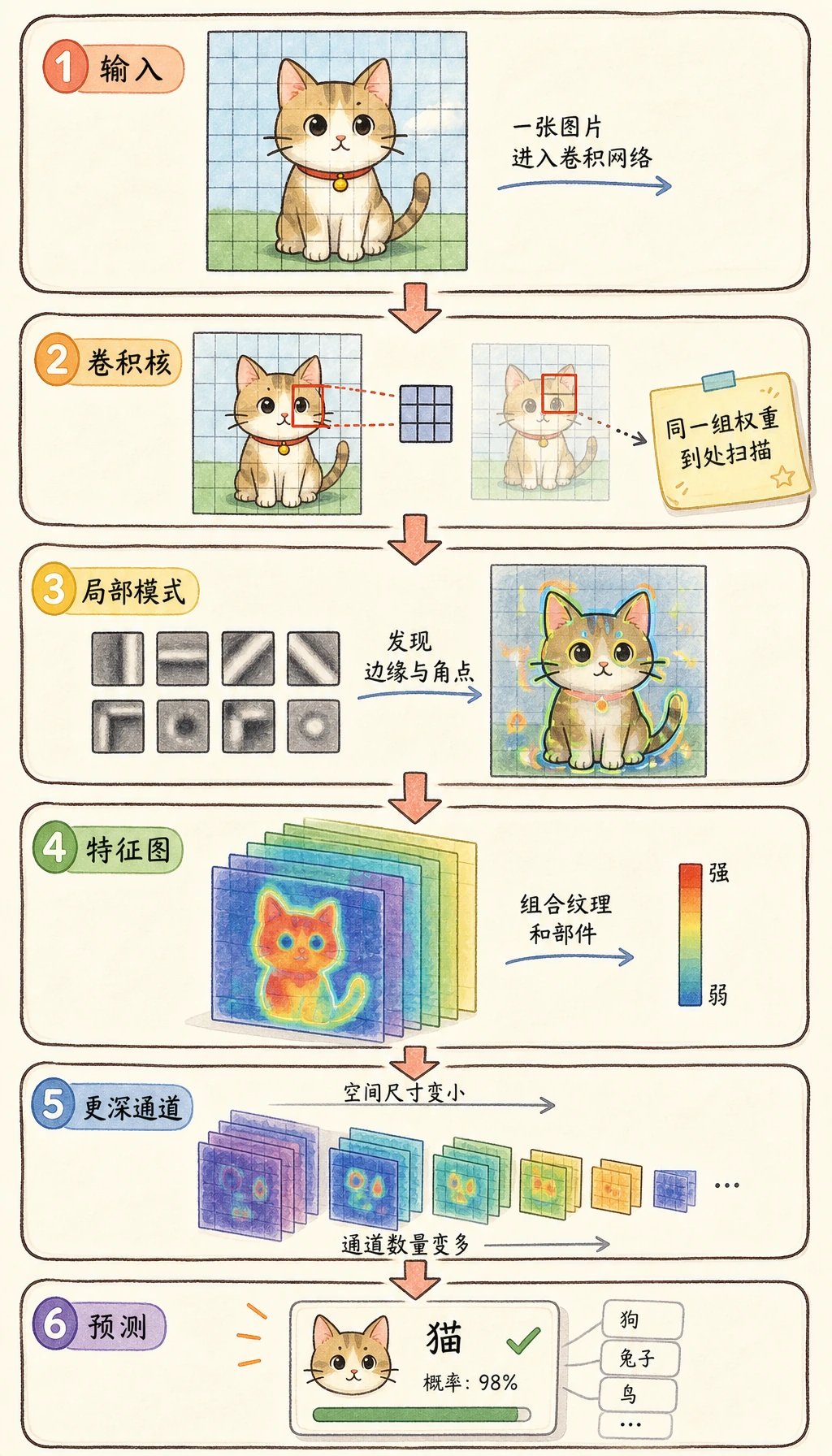
按从左到右读图:
图像 -> 低层特征 -> 压缩后的 feature map -> 分类头 -> 类别分数
CNN 通常分成两部分:
| 部分 | 作用 | 常见层 |
|---|---|---|
| feature extractor | 把像素变成有用的 feature map | Conv2d、ReLU、BatchNorm2d、MaxPool2d |
| classifier head | 把最后的 feature map 变成类别分数 | Flatten 或 GAP、Linear |
最后一层输出通常叫 logits:也就是进入 softmax 之前的原始类别分数。
通道数变多,空间尺寸变小
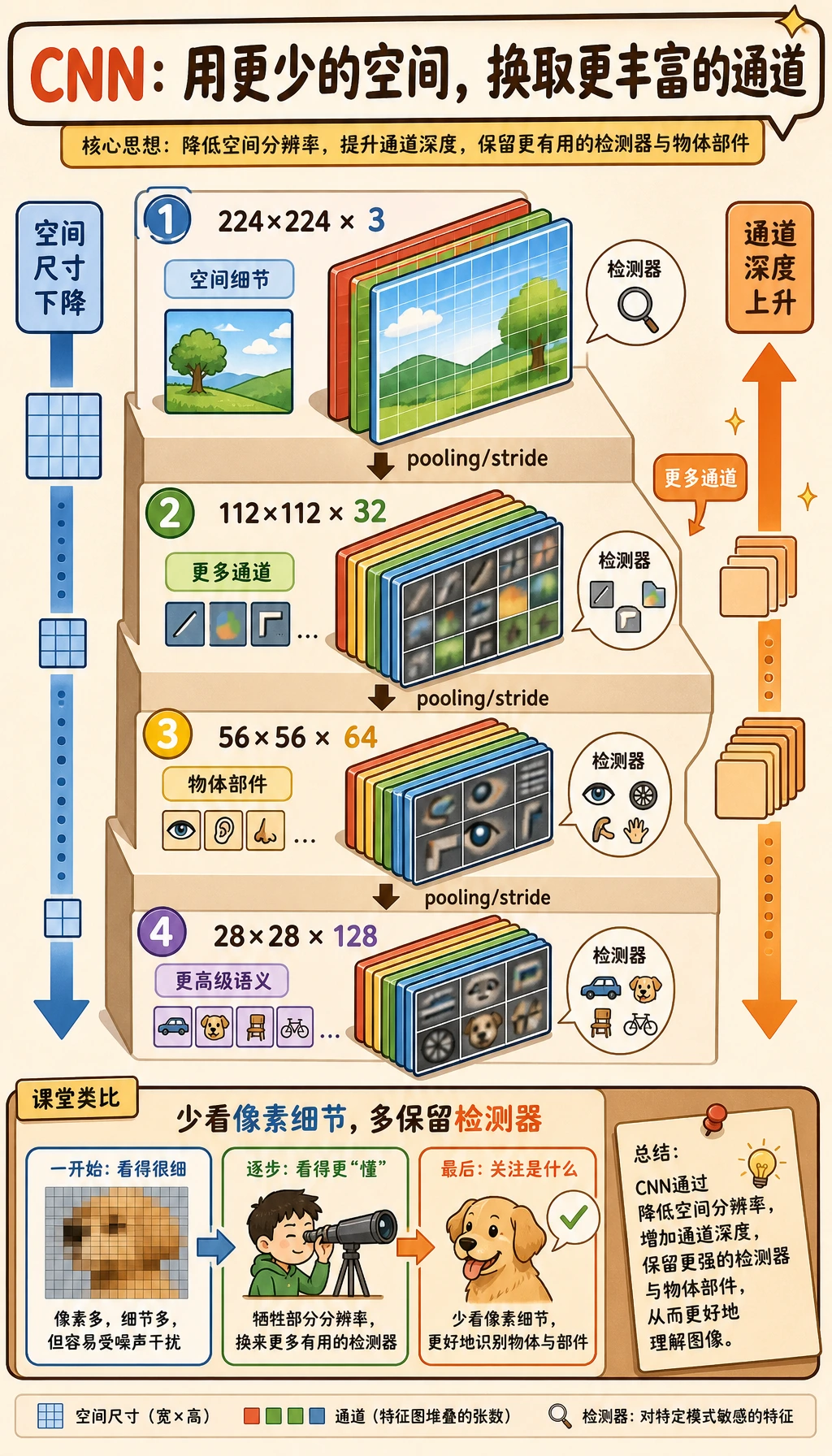
浅层保留更多空间细节。深层保留更少像素位置,但保存更多特征类型。
| 阶段 | shape 直觉 | 含义 |
|---|---|---|
| input | [N, 3, 32, 32] | RGB 图像 |
| early feature | [N, 16, 32, 32] | 多种边缘、纹理检测器 |
| after pooling | [N, 16, 16, 16] | 更小的图,保留局部最强信号 |
| deeper feature | [N, 64, 8, 8] | 更抽象的模式 |
这是 CNN 设计的核心取舍:
- 更少的空间位置可以减少计算;
- 更多的通道可以存储更丰富的视觉证据;
- 分类头应该看到足够语义,而不是每一个原始像素。
实验 1:手算 MaxPool
MaxPool2d(2) 会在每个 2 x 2 窗口里保留最大值。
import numpy as np

feature_map = np.array(
    [
        [1, 3, 2, 0],
        [4, 6, 1, 2],
        [0, 1, 5, 3],
        [2, 4, 1, 7],
    ],
    dtype=np.float32,
)

pooled = np.array(
    [
        [feature_map[0:2, 0:2].max(), feature_map[0:2, 2:4].max()],
        [feature_map[2:4, 0:2].max(), feature_map[2:4, 2:4].max()],
    ]
)

print("maxpool_lab")
print(pooled)
预期输出:
maxpool_lab
[[6. 2.]
 [4. 7.]]
池化会丢掉一部分细节,但它保留了局部最强响应。对分类任务来说,这通常是有用的偏置:模型更关心某个特征是否出现,而不是它精确出现在哪个像素。
实验 2:运行一个卷积块
一个基础 CNN block 是:
Conv2d -> activation -> optional pooling
运行:
import torch
from torch import nn

block = nn.Sequential(
    nn.Conv2d(3, 8, kernel_size=3, padding=1),
    nn.ReLU(),
    nn.MaxPool2d(kernel_size=2),
)

x = torch.randn(2, 3, 32, 32)
y = block(x)

print("block_lab")
print("input:", tuple(x.shape))
print("output:", tuple(y.shape))
预期输出:
block_lab
input: (2, 3, 32, 32)
output: (2, 8, 16, 16)
变化在哪里:
- batch 仍然是
2; - 通道从
3变成8; - 高和宽因为
MaxPool2d(2)从32缩到16。
实际项目里常见的变体是:
Conv2d -> BatchNorm2d -> ReLU
BatchNorm2d 可以在训练时稳定 feature 的尺度。它很有用,但第一次搭模型时,先把 shape 流程看清楚更重要。
实验 3:搭建完整 Tiny CNN
这个模型接收灰度 28 x 28 图像,并输出 10 个类别分数。
import torch
from torch import nn


class TinyCNN(nn.Module):
    def __init__(self, num_classes=10):
        super().__init__()
        self.conv1 = nn.Conv2d(1, 8, kernel_size=3, padding=1)
        self.pool1 = nn.MaxPool2d(2)
        self.conv2 = nn.Conv2d(8, 16, kernel_size=3, padding=1)
        self.pool2 = nn.MaxPool2d(2)
        self.classifier = nn.Sequential(
            nn.Flatten(),
            nn.Linear(16 * 7 * 7, 64),
            nn.ReLU(),
            nn.Linear(64, num_classes),
        )

    def forward(self, x):
        print("shape_trace")
        print(f"{'input':<8} {tuple(x.shape)}")
        x = torch.relu(self.conv1(x))
        print(f"{'conv1':<8} {tuple(x.shape)}")
        x = self.pool1(x)
        print(f"{'pool1':<8} {tuple(x.shape)}")
        x = torch.relu(self.conv2(x))
        print(f"{'conv2':<8} {tuple(x.shape)}")
        x = self.pool2(x)
        print(f"{'pool2':<8} {tuple(x.shape)}")
        x = self.classifier(x)
        print(f"{'logits':<8} {tuple(x.shape)}")
        return x


model = TinyCNN(num_classes=10)
x = torch.randn(4, 1, 28, 28)
_ = model(x)
预期输出:
shape_trace
input    (4, 1, 28, 28)
conv1    (4, 8, 28, 28)
pool1    (4, 8, 14, 14)
conv2    (4, 16, 14, 14)
pool2    (4, 16, 7, 7)
logits   (4, 10)
最后 shape 是 [4, 10],因为 batch 里有 4 张图,每张图输出 10 个分数。
像工程师一样读结构
看 CNN 时,不要只读层名,要追踪每个边界的 tensor contract。
| 代码行 | 要检查的约定 |
|---|---|
Conv2d(1, 8, ...) | 输入必须有 1 个通道 |
MaxPool2d(2) | 高和宽会除以 2 |
Conv2d(8, 16, ...) | 上一层输出通道必须是 8 |
Linear(16 * 7 * 7, 64) | flatten 后的特征数必须和真实 feature map 一致 |
最后的 Linear(..., 10) | 输出维度必须等于类别数 |
大多数 CNN 报错都是 contract 报错:到达某一层的 tensor shape 和这层期待的不一样。
Flatten 和 Global Average Pooling
Flatten 会把所有空间位置拉成一个长向量:
[N, 16, 7, 7] -> [N, 784]
GAP 每个通道只保留一个平均值:
[N, 16, 7, 7] -> [N, 16]
比较参数量:
from torch import nn


def count_params(module):
    return sum(p.numel() for p in module.parameters() if p.requires_grad)


flatten_head = nn.Linear(16 * 7 * 7, 10)
gap_head = nn.Linear(16, 10)

print("head_param_lab")
print("flatten head:", count_params(flatten_head))
print("gap head    :", count_params(gap_head))
预期输出:
head_param_lab
flatten head: 7850
gap head    : 170
取舍可以这样看:
| Head | 优点 | 代价 |
|---|---|---|
| Flatten + Linear | 简单,能使用位置相关细节 | 参数多,输入尺寸更固定 |
| GAP + Linear | 紧凑,更容易适配变化的空间尺寸 | 可能丢掉精细位置信息 |
现代 CNN 分类器经常用 GAP,因为它能降低过拟合风险,并让 head 更小。
常见错误
| 错误 | 现象 | 修复 |
|---|---|---|
| 通道顺序写错 | expected input ... to have C channels | PyTorch 中使用 [N, C, H, W] |
Linear 输入尺寸写错 | 矩阵乘法 shape 报错 | 在 Flatten 前打印 shape |
| 太早、太多 pooling | feature map 变得过小 | 每个 block 后追踪 H 和 W |
| 把 logits 当概率 | loss 或评估理解混乱 | CrossEntropyLoss 直接吃 logits;展示时再 softmax |
| 加了 BatchNorm 却不理解模式 | train/eval 行为不同 | 训练用 model.train(),评估用 model.eval() |
练习
- 把
conv2的输出通道从16改成32,哪些行必须跟着改? - 用
AdaptiveAvgPool2d((1, 1))、Flatten和Linear(16, 10)替换分类头。 - 删除一个 pooling 层,先预测新的 flatten 尺寸,再运行代码验证。
- 在
conv1后加入BatchNorm2d(8),确认 shape 不变。 - 针对 RGB
64 x 64输入,手写每一层后的 shape。
小结
- CNN 是 feature extractor 加 classifier head。
- 卷积块增加特征通道;pooling 或 stride 通常降低空间尺寸。
- shape tracing 是调试 CNN 结构最快的方法。
Flatten简单但参数多;GAP 更紧凑,在现代 CNN 中很常见。- 好的 CNN 设计重点是控制信息流,而不是盲目堆层数。