6.5.2 注意力机制
本节定位
RNN 是一步步传信息。注意力让一个 token 直接看其他 token,并判断哪些更重要。这是 Transformer 背后的核心转变。
学习目标
- 解释为什么注意力有助于长距离依赖。
- 通过检索类比理解 Query、Key、Value。
- 手算 scaled dot-product attention。
- 使用 causal mask 防止偷看未来。
- 读懂 PyTorch 中
nn.MultiheadAttention的 shape。
先看 Q/K/V
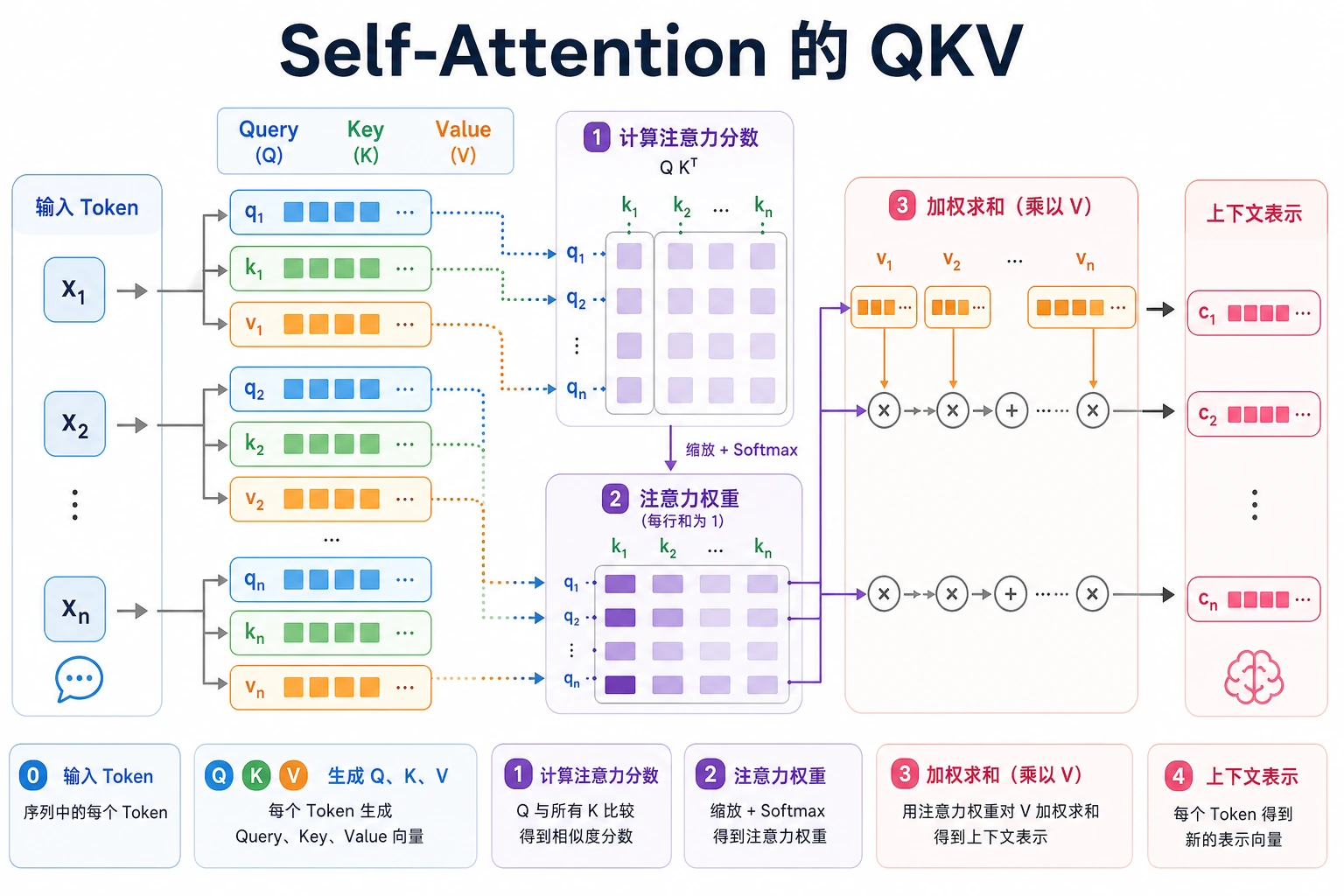
注意力是一种加权检索:
Q 提问 -> K 匹配 -> softmax 变成权重 -> V 提供内容 -> 加权求和
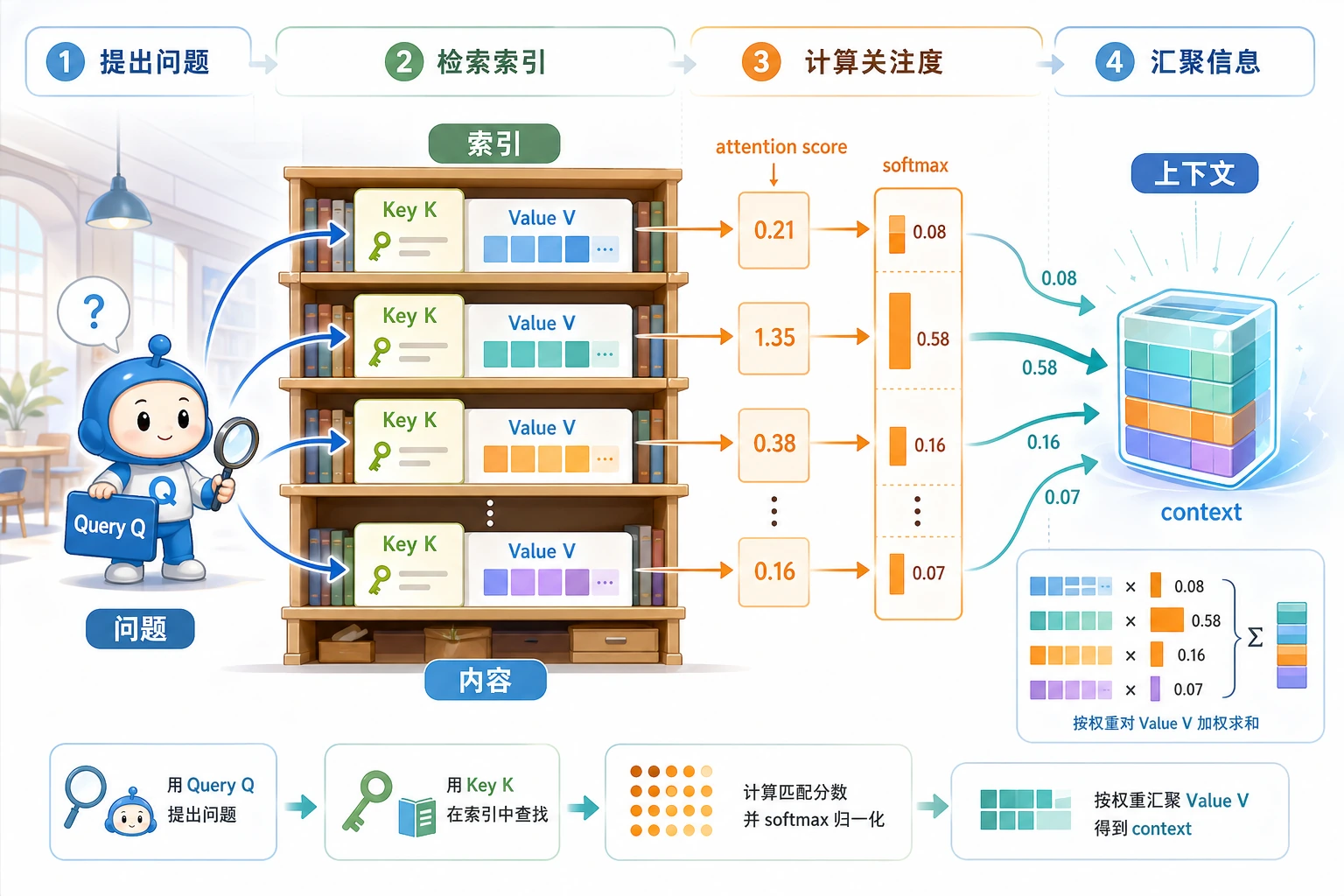
检索类比:
| 角色 | 直觉 | 在注意力中 |
|---|---|---|
Query Q | 我现在想找什么? | 当前 token 的问题 |
Key K | 每个条目匹配什么? | 用来打分的索引 |
Value V | 应该返回什么内容? | 实际被混合的信息 |
一句话:
Q 和 K 打分,然后用得到的权重混合 V。
为什么需要注意力
旧式序列模型中,远处信息要么沿很多个循环步骤传递,要么被压进一个固定向量。注意力缩短了路径:
当前 token -> 直接给所有 token 打分 -> 选择有用上下文
它带来三个实践优势:
- 直接建立长距离连接;
- 比一步步 RNN 更容易并行训练;
- 得到可观察的 token-to-token 混合权重矩阵。
实验 1:手算注意力
为了教学,令 Q = K = V = X。
import numpy as np

X = np.array(
    [
        [1.0, 0.0],
        [0.0, 1.0],
        [1.0, 1.0],
    ]
)

Q = K = V = X

scores = Q @ K.T
scaled_scores = scores / np.sqrt(K.shape[1])


def softmax(row):
    e = np.exp(row - row.max())
    return e / e.sum()


weights = np.apply_along_axis(softmax, 1, scaled_scores)
output = weights @ V

print("attention_lab")
print("scores")
print(np.round(scores, 3))
print("weights")
print(np.round(weights, 3))
print("output")
print(np.round(output, 3))
预期输出:
attention_lab
scores
[[1. 0. 1.]
 [0. 1. 1.]
 [1. 1. 2.]]
weights
[[0.401 0.198 0.401]
 [0.198 0.401 0.401]
 [0.248 0.248 0.503]]
output
[[0.802 0.599]
 [0.599 0.802]
 [0.752 0.752]]
读这三步:
| 步骤 | 代码 | 含义 |
|---|---|---|
| 打分 | Q @ K.T | 每个 token 和每个 token 有多匹配 |
| 归一化 | softmax(...) | 把分数变成和为 1 的权重 |
| 混合 | weights @ V | 按权重组合 token 内容 |
为什么要除以 sqrt(d_k)?
Transformer 里的公式是:
Attention(Q, K, V) = softmax(QK^T / sqrt(d_k))V
当向量维度很大时,点积也容易变大。大分数会让 softmax 过于尖锐,某个 token 几乎拿走全部权重。除以 sqrt(d_k) 可以给分数降温,让训练更稳定。
Self-Attention
Self-attention 指 Q、K、V 都来自同一个序列。每个 token 都能看同一个序列里的每个 token。
例子:
"Alex gave Sam the notebook because he trusted him."
要理解 “he” 和 “him”,当前 token 需要看其他 token。Self-attention 给了这种直接路径。
实验 2:Causal Mask
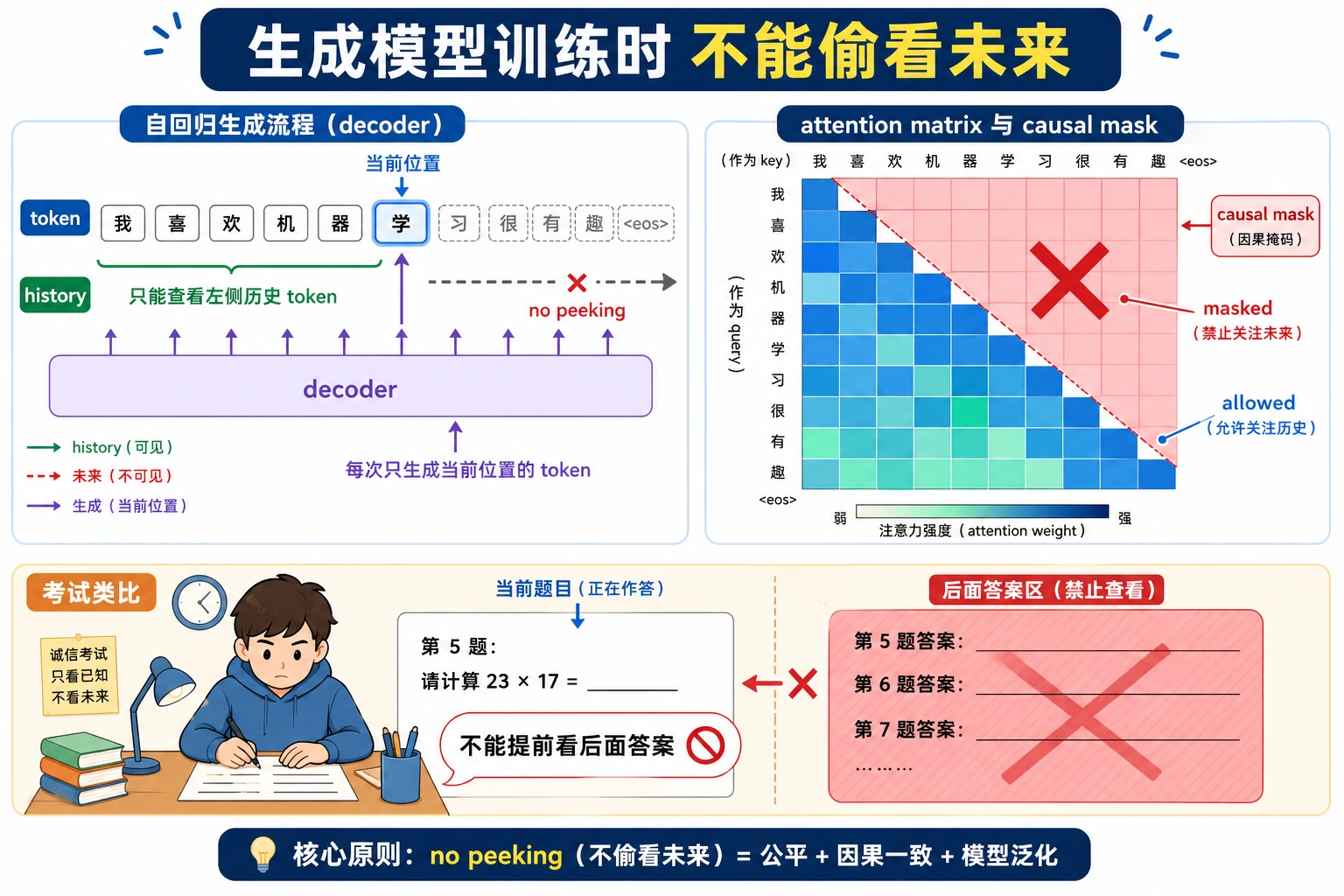
生成任务不能看未来 token。causal mask 只让下三角可见。
import numpy as np

scores = np.array(
    [
        [2.0, 1.0, 0.5],
        [1.2, 2.1, 0.7],
        [0.8, 1.3, 2.2],
    ]
)

mask = np.tril(np.ones_like(scores))
masked_scores = np.where(mask == 1, scores, -1e9)


def softmax(row):
    e = np.exp(row - row.max())
    return e / e.sum()


weights = np.apply_along_axis(softmax, 1, masked_scores)

print("mask_lab")
print(np.round(weights, 3))
预期输出:
mask_lab
[[1.    0.    0.   ]
 [0.289 0.711 0.   ]
 [0.149 0.246 0.605]]
读法:
- 位置 1 只能看自己;
- 位置 2 能看位置 1 和 2;
- 位置 3 能看位置 1、2、3。
未来答案不可见。
Multi-Head Attention
一个 attention head 可能只学到一种关系。multi-head attention 让模型并行查看多个关系空间。
不同 head 可能关注:
- 附近位置模式;
- 主语 / 宾语关系;
- 重复词;
- 长距离引用。
多个 head 的结果会拼接,再投影回一个表示。
实验 3:PyTorch MultiheadAttention
import torch
from torch import nn

torch.manual_seed(42)

attention = nn.MultiheadAttention(embed_dim=8, num_heads=2, batch_first=True)
tokens = torch.randn(1, 4, 8)
output, weights = attention(tokens, tokens, tokens)

print("mha_lab")
print("tokens:", tuple(tokens.shape))
print("output:", tuple(output.shape))
print("weights:", tuple(weights.shape))
print("row0_sum:", round(float(weights[0, 0].sum().detach()), 4))
预期输出:
mha_lab
tokens: (1, 4, 8)
output: (1, 4, 8)
weights: (1, 4, 4)
row0_sum: 1.0
shape 读法:
| Tensor | Shape | 含义 |
|---|---|---|
tokens | [1, 4, 8] | batch 1,4 个 token,embedding size 8 |
output | [1, 4, 8] | 每个 token 得到新的上下文表示 |
weights | [1, 4, 4] | 每个 query token 对 4 个 key token 分配权重 |
Attention 权重不是完整解释
Attention 权重很有用,但不要过度解读。
它能说明:
在这一层 / 这个 head 中,这个 query 从那些 key 位置混合了更多 value
它不能自动证明:
模型最终决策就是因为那个 token
把 attention 权重当作调试和观察工具,而不是完整因果解释。
常见错误
| 错误 | 修复 |
|---|---|
| 把 Q/K/V 当神秘变量 | 读成 问题 / 索引 / 内容 |
| 忘记 shape 含义 | 追踪 [batch, seq_len, embed_dim] 和 attention [batch, query, key] |
| 生成任务不用 mask | 用 causal mask 隐藏未来 token |
在错误维度上 softmax | 应该在 key 位置上归一化 |
| 把 attention 当推理魔法 | 记住:打分 -> softmax -> 加权求和 |
练习
- 把实验 1 的第三个 token 改成
[2.0, 0.0],weights 怎么变? - 把 mask 实验扩展成
4 x 4矩阵。 - 把实验 3 的
num_heads从2改成1,哪些 shape 不变? - 解释为什么 attention 比普通 RNN 更容易建模远距离 token 交互。
- 描述一个 attention 权重有帮助但不是完整解释的场景。
小结
- Attention 让 token 直接选择相关上下文。
- Q/K/V 把打分和内容检索分开。
- Scaled dot-product attention 是打分、softmax、加权求和。
- Causal mask 防止生成任务偷看未来。
- Multi-head attention 从多个子空间查看关系。