5.2.4 决策树
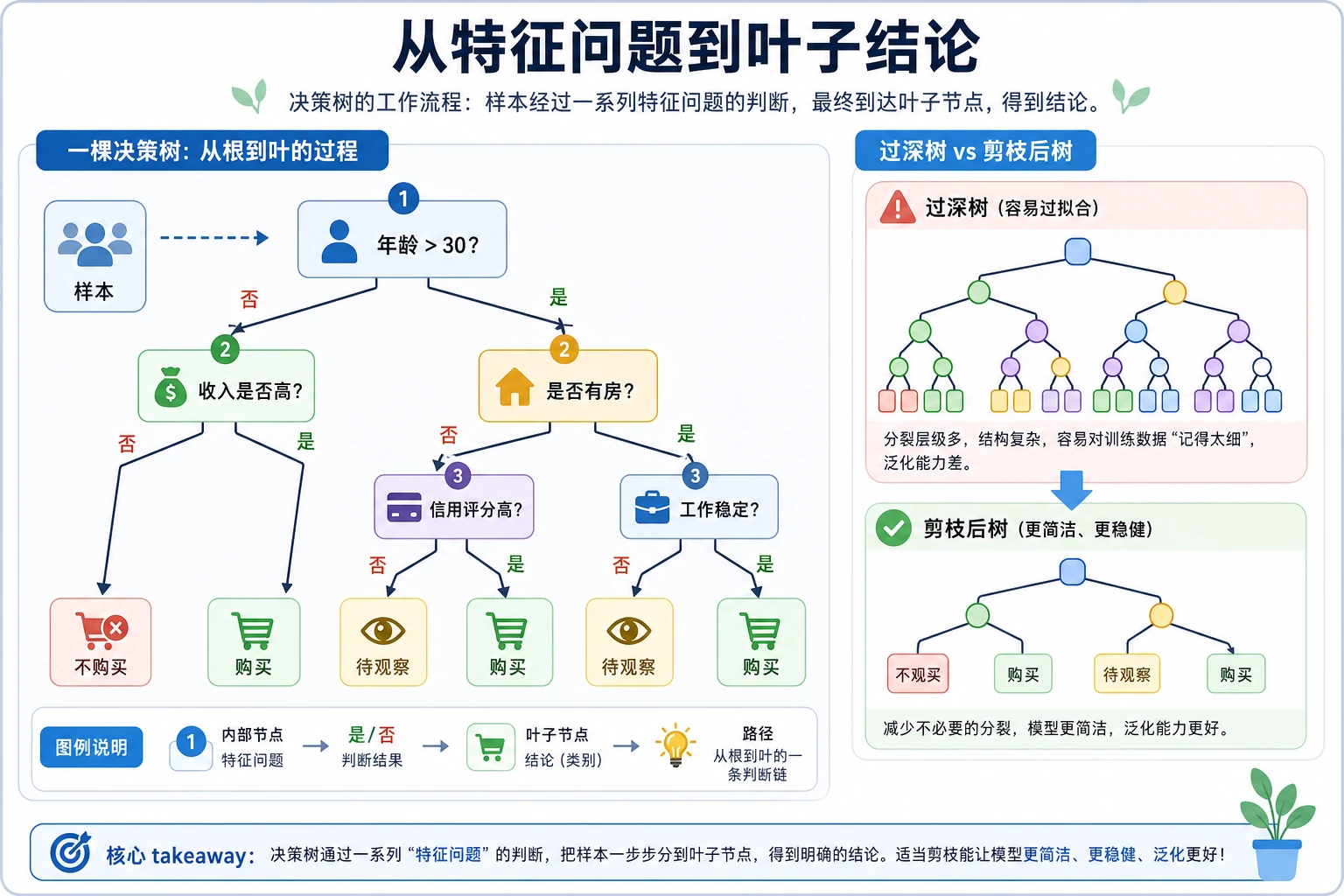
决策树是由一连串问题组成的模型。它容易读懂,因为每个预测都会沿着规则路径往下走;但如果规则过细,它也很容易过拟合。
你会做出什么
这一节会通过一个脚本演示:
- 树的深度如何影响训练集/测试集准确率;
- 如何打印可读的树规则;
- 特征重要性如何来自划分;
ccp_alpha后剪枝如何改变叶子数量;- 回归树如何做出阶梯状的数值预测。
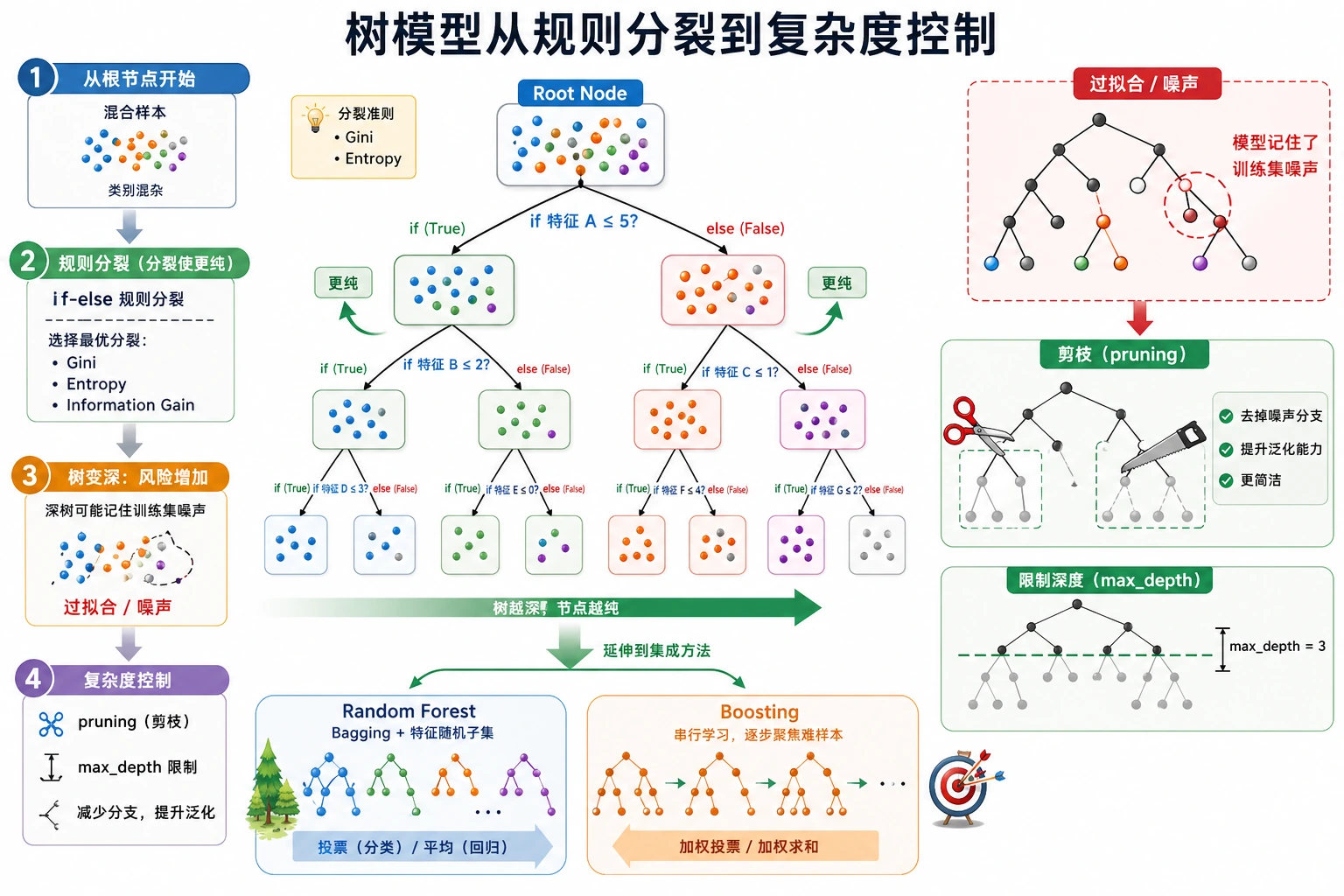
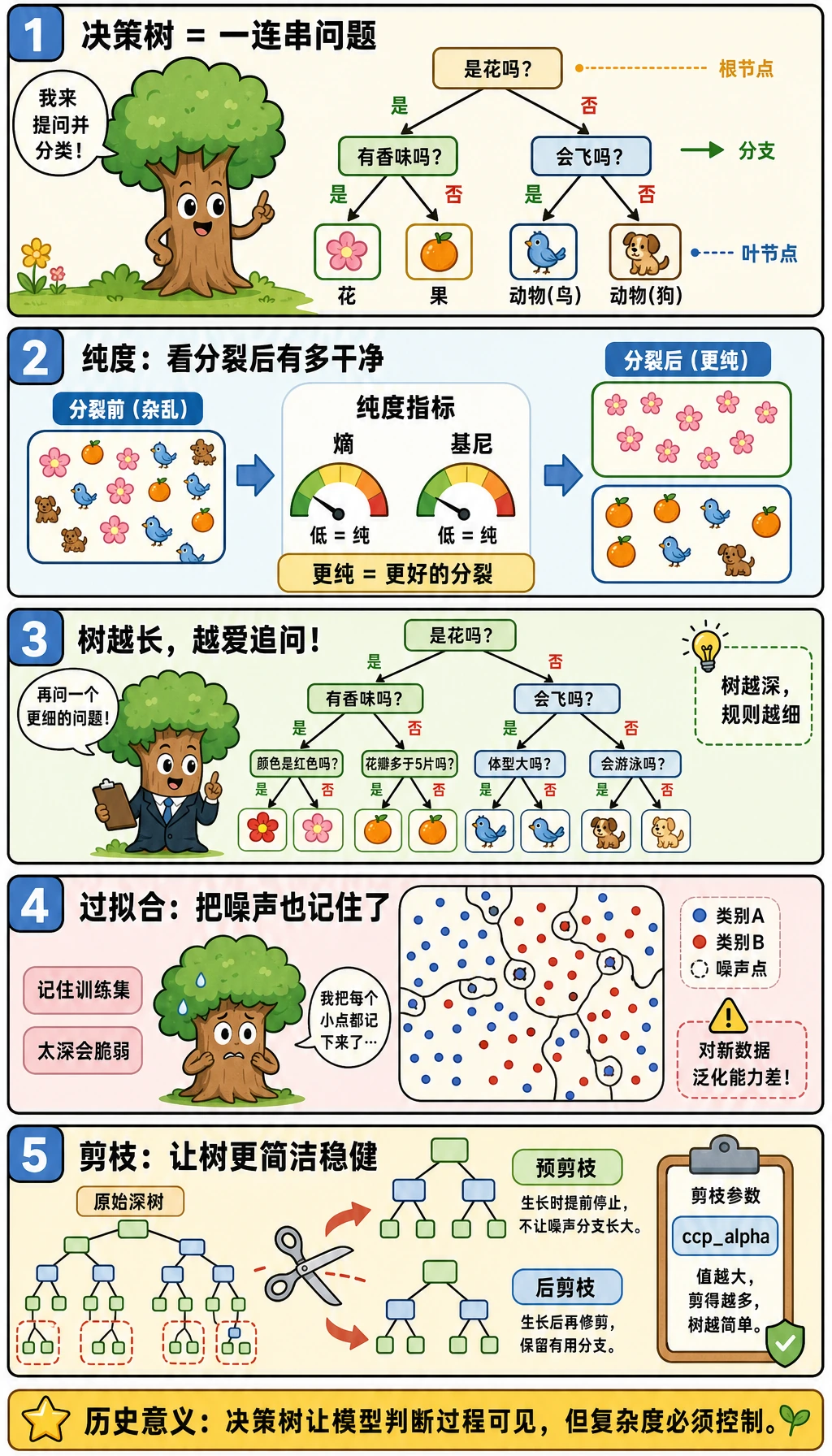
先看图。决策树不是简单的 “if-else”,而是 “if-else + 划分评分 + 复杂度控制”。
环境准备
python -m pip install -U scikit-learn
本节使用 sklearn 的 CART 风格 DecisionTreeClassifier 和 DecisionTreeRegressor。CART 是 Classification and Regression Trees,分类与回归树,意思是同一套树思想既能处理类别,也能处理数值。
运行完整实验
新建 decision_tree_lab.py:
from sklearn.datasets import load_diabetes, load_iris
from sklearn.metrics import accuracy_score, mean_absolute_error
from sklearn.model_selection import train_test_split
from sklearn.tree import DecisionTreeClassifier, DecisionTreeRegressor, export_text


iris = load_iris()
X = iris.data[:, 2:4]  # petal length and petal width, easier to read
y = iris.target
X_train, X_test, y_train, y_test = train_test_split(
    X, y, test_size=0.25, random_state=42, stratify=y
)

print("classification_depth_lab")
for depth in [1, 2, 3, None]:
    tree = DecisionTreeClassifier(max_depth=depth, min_samples_leaf=3, random_state=42)
    tree.fit(X_train, y_train)
    train_acc = accuracy_score(y_train, tree.predict(X_train))
    test_acc = accuracy_score(y_test, tree.predict(X_test))
    print(
        f"max_depth={str(depth):<4} "
        f"train={train_acc:.3f} test={test_acc:.3f} "
        f"leaves={tree.get_n_leaves()} depth={tree.get_depth()}"
    )

best_tree = DecisionTreeClassifier(max_depth=3, min_samples_leaf=3, random_state=42)
best_tree.fit(X_train, y_train)
print("tree_rules")
print(export_text(best_tree, feature_names=["petal length", "petal width"], decimals=2, max_depth=3))

print("feature_importance")
for name, value in zip(["petal length", "petal width"], best_tree.feature_importances_):
    print(f"- {name}: {value:.3f}")

print("pruning_lab")
path = DecisionTreeClassifier(random_state=42).cost_complexity_pruning_path(X_train, y_train)
for alpha in path.ccp_alphas[[0, 1, -2]]:
    pruned = DecisionTreeClassifier(random_state=42, ccp_alpha=float(alpha))
    pruned.fit(X_train, y_train)
    print(
        f"ccp_alpha={alpha:.4f} "
        f"test={accuracy_score(y_test, pruned.predict(X_test)):.3f} "
        f"leaves={pruned.get_n_leaves()}"
    )

print("regression_tree_lab")
diabetes = load_diabetes()
X_train, X_test, y_train, y_test = train_test_split(
    diabetes.data, diabetes.target, test_size=0.25, random_state=42
)
for depth in [2, 4, None]:
    reg = DecisionTreeRegressor(max_depth=depth, min_samples_leaf=10, random_state=42)
    reg.fit(X_train, y_train)
    pred = reg.predict(X_test)
    print(f"max_depth={str(depth):<4} mae={mean_absolute_error(y_test, pred):.1f} leaves={reg.get_n_leaves()}")
运行:
python decision_tree_lab.py
预期输出:
classification_depth_lab
max_depth=1    train=0.670 test=0.658 leaves=2 depth=1
max_depth=2    train=0.964 test=0.947 leaves=3 depth=2
max_depth=3    train=0.982 test=0.974 leaves=5 depth=3
max_depth=None train=0.982 test=0.974 leaves=5 depth=3
tree_rules
|--- petal length <= 2.45
|   |--- class: 0
|--- petal length >  2.45
|   |--- petal width <= 1.70
|   |   |--- petal length <= 4.95
|   |   |   |--- class: 1
|   |   |--- petal length >  4.95
|   |   |   |--- class: 2
|   |--- petal width >  1.70
|   |   |--- petal length <= 4.95
|   |   |   |--- class: 2
|   |   |--- petal length >  4.95
|   |   |   |--- class: 2

feature_importance
- petal length: 0.588
- petal width: 0.412
pruning_lab
ccp_alpha=0.0000 test=0.921 leaves=7
ccp_alpha=0.0067 test=0.921 leaves=5
ccp_alpha=0.2636 test=0.658 leaves=2
regression_tree_lab
max_depth=2    mae=47.3 leaves=4
max_depth=4    mae=44.4 leaves=14
max_depth=None mae=48.7 leaves=25
读懂输出
第一段最重要:
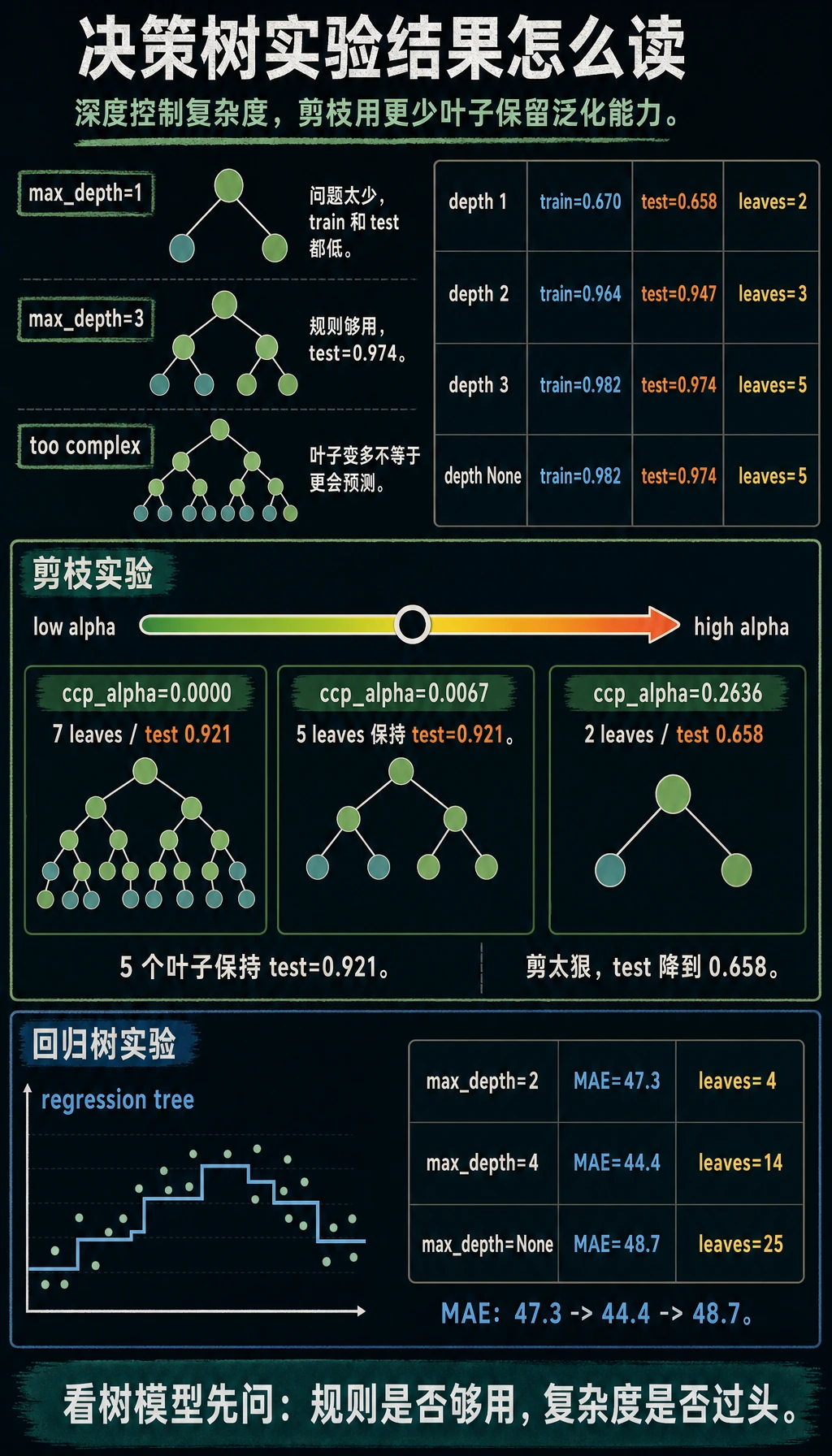
max_depth=1    train=0.670 test=0.658 leaves=2 depth=1
max_depth=3    train=0.982 test=0.974 leaves=5 depth=3
max_depth=1 只问一个问题,模型太简单。max_depth=3 会继续追问几轮,效果明显更好。在这个小数据集上,max_depth=None 没有继续长得更深,因为 min_samples_leaf=3 限制了过小叶子,而且数据本身比较简单。
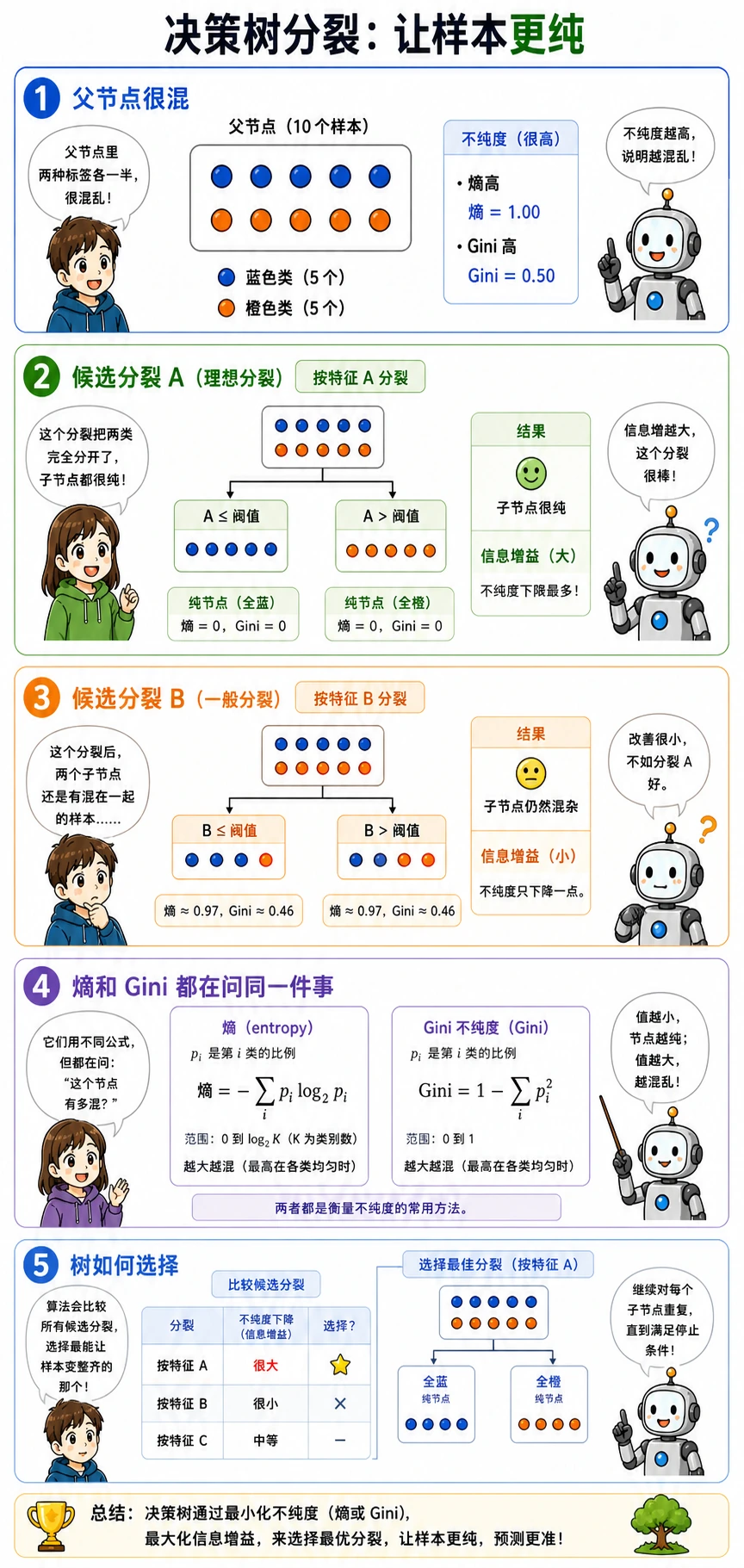
每个节点都会寻找这样的问题:
petal length <= 2.45?
好的划分会让子节点比父节点更“干净”。干净的意思是,一个节点里的标签更少混杂。
Gini、熵与信息增益
第一次学习时,不需要立刻背所有公式。先记住它们的工作:
| 术语 | 实用含义 |
|---|---|
Gini | 衡量节点里标签有多混杂;sklearn 分类树默认值 |
entropy | 另一种混杂程度评分,和信息论有关 |
information gain | 划分后混杂程度下降了多少 |
criterion | 选择评分规则的参数,例如 criterion="gini" 或 criterion="entropy" |
没有特殊理由时,先用 gini。很多表格项目里,调树深、叶子大小和剪枝,比把 Gini 换成 entropy 更关键。
控制复杂度
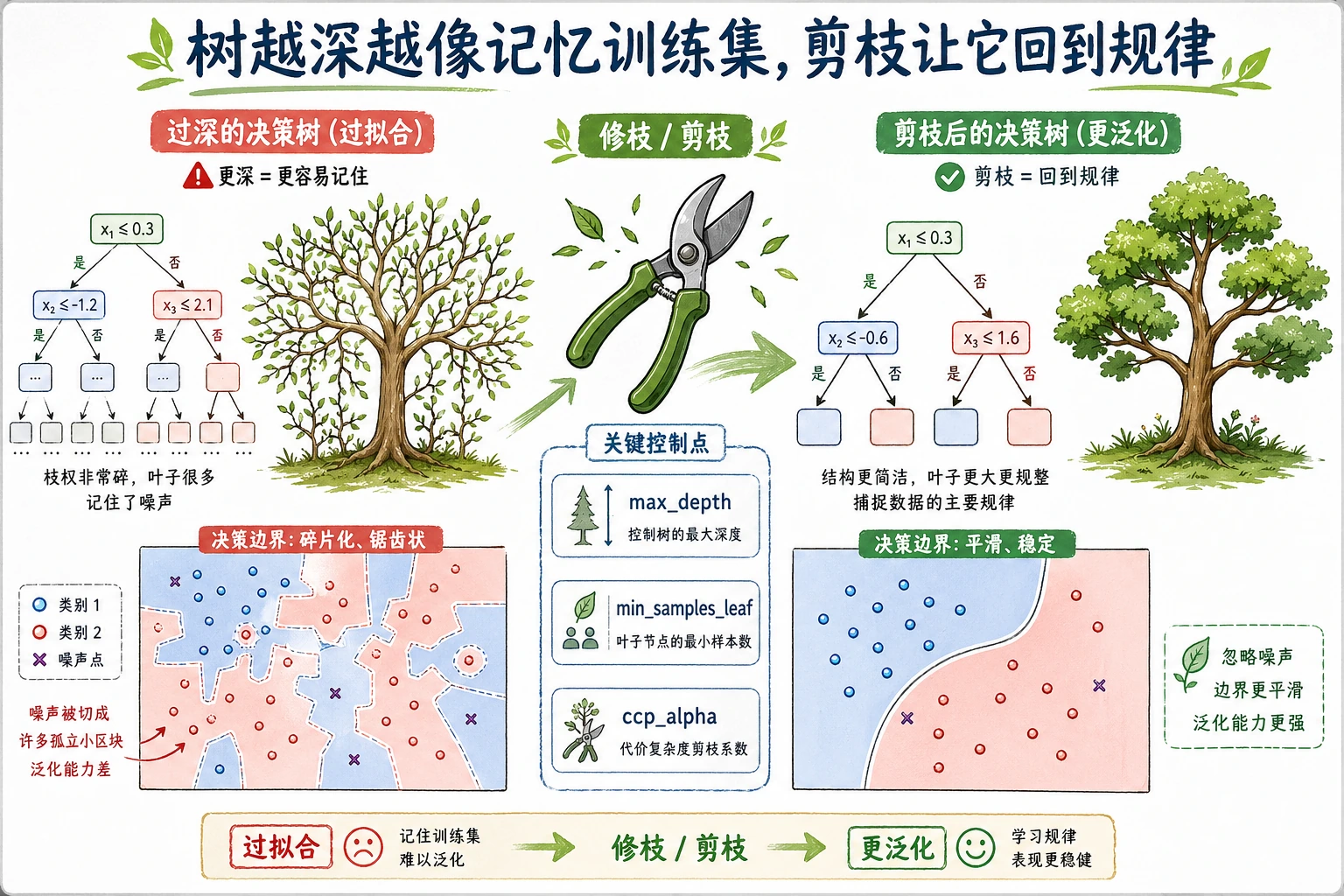
实操调参顺序:
- 先设置
max_depth,防止树长得过深。 - 再设置
min_samples_leaf,让每个叶子至少有足够样本。 - 最后用
ccp_alpha对已经长出来的树做后剪枝。
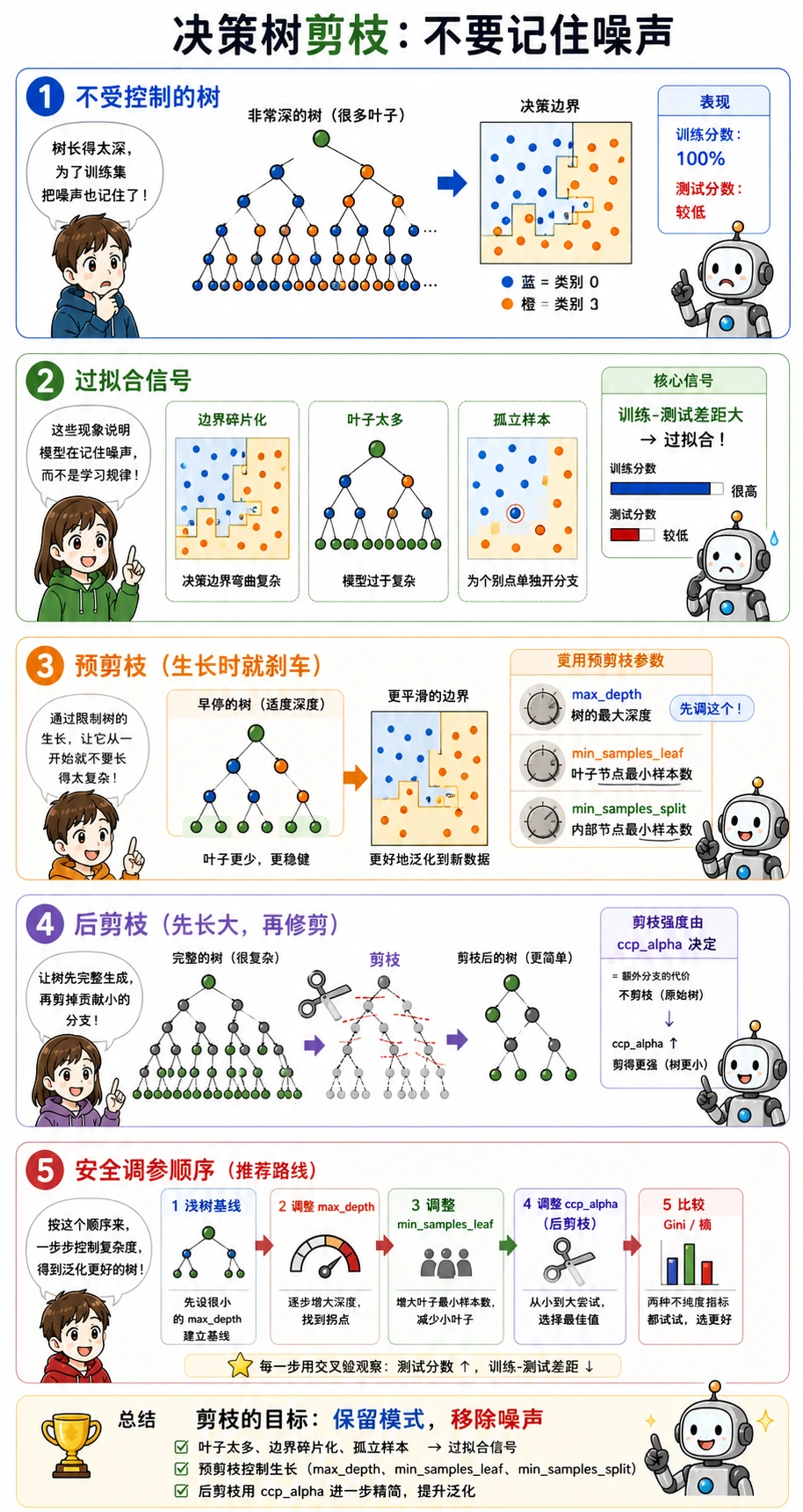
剪枝输出展示了取舍:
ccp_alpha=0.0000 test=0.921 leaves=7
ccp_alpha=0.0067 test=0.921 leaves=5
ccp_alpha=0.2636 test=0.658 leaves=2
轻微剪枝保留了测试分数,同时叶子更少。剪得太重时,树只剩两个叶子,很多有用规则也丢了。
解释性
export_text() 会打印样本会走过的规则路径。给同事解释预测原因时很有用:
|--- petal length <= 2.45
|   |--- class: 0
特征重要性也有价值,但要谨慎:
- 它表示这个已训练树中,哪些特征降低纯度最多;
- 它可能偏爱可划分点更多的特征;
- 相关特征之间会分摊或掩盖重要性;
- 它不等于因果重要性。
后面做更严谨解释时,可以把树的重要性和 permutation importance 对照。
回归树
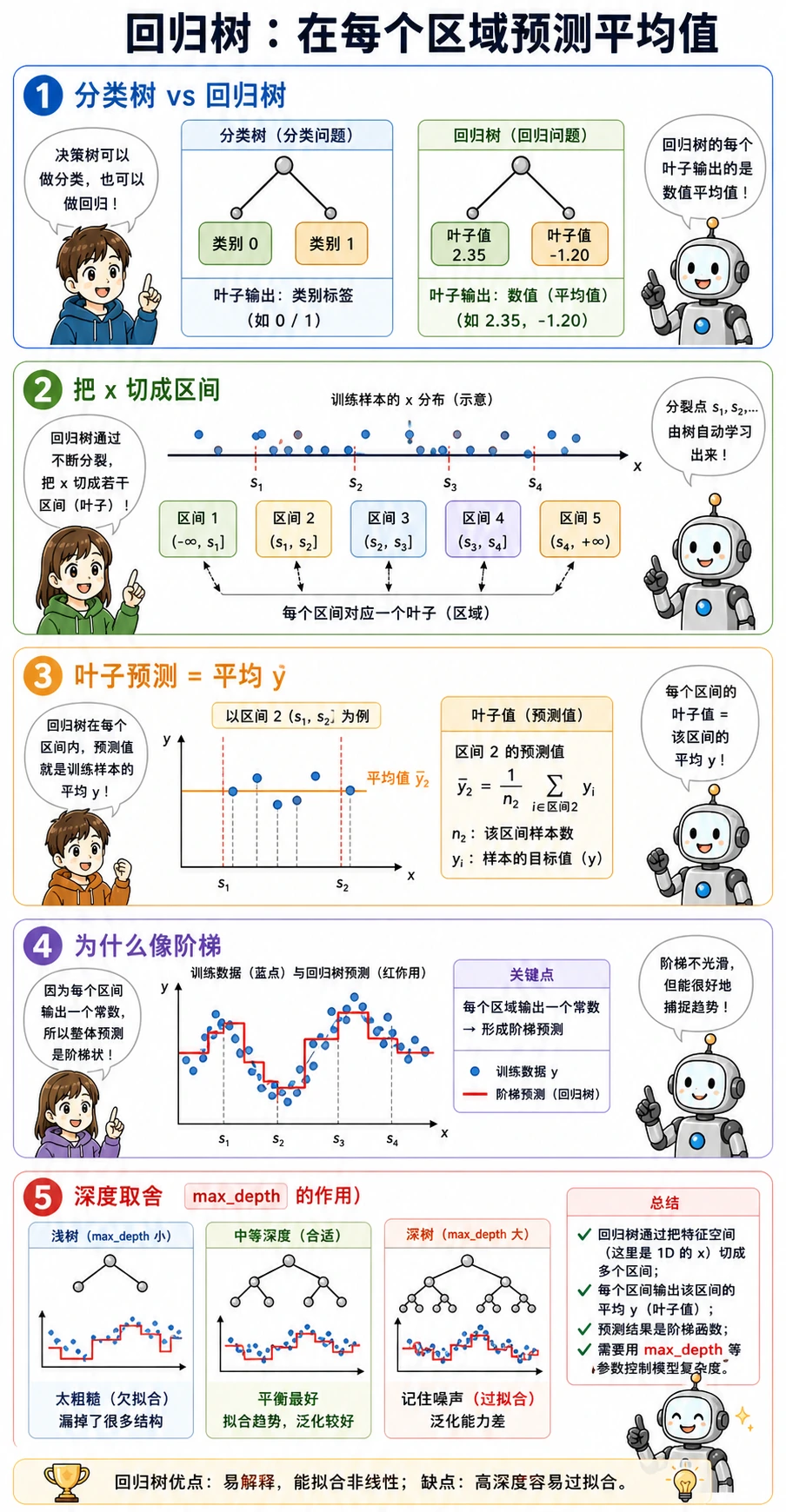
回归树预测数值,但思想相同:把特征空间切成多个区域,然后每个叶子输出目标值平均数。
所以回归树的预测常常像阶梯,而不是光滑直线。实验里:
max_depth=4    mae=44.4 leaves=14
max_depth=None mae=48.7 leaves=25
更深的树叶子更多,但测试 MAE 反而更差。规则更多不等于泛化更好。
什么时候用单棵决策树
适合使用单棵树的场景:
- 需要一个快速、可解释的基线;
- 需要把模型规则提取给业务流程;
- 想用可视化方式解释非线性划分;
- 作为 Random Forest 或 boosting 前的垫脚石。
不建议只依赖单棵树的场景:
- 数据稍微变化,树结构就大变;
- 测试分数远低于训练分数;
- 问题需要集成模型的准确性和稳定性。
常见排查清单
| 现象 | 可能原因 | 修复方式 |
|---|---|---|
| 训练分数高,测试分数低 | 树太深 | 降低 max_depth,提高 min_samples_leaf,尝试剪枝 |
| 叶子很多且很小 | 正在记住少数特殊样本 | 提高 min_samples_leaf |
| 特征重要性不可信 | 特征相关或高基数特征影响 | 用 permutation importance 复核 |
| 规则难读 | 树太大 | 训练一棵更小的解释树,或只总结关键路径 |
| 回归树预测像一格一格的台阶 | 叶子平均值导致阶梯输出 | 对比线性模型、随机森林或梯度提升 |
练习
- 把
min_samples_leaf从3改成1,再改成10。叶子数和测试准确率怎么变? - 把
criterion改成"entropy"。第一层划分还一样吗? - 打印
max_depth=2的export_text()。是不是更容易解释? - Iris 改成使用四个特征。特征重要性会变化吗?
- 在回归树部分,把结果和线性回归课程里的基线对比。
过关检查
你能解释下面几点,就完成本节:
- 树通过选择让子节点更干净的划分来学习;
- 树越深,越容易记住训练集;
max_depth、min_samples_leaf、ccp_alpha都在控制复杂度;- 特征重要性有用,但不等于因果关系;
- 回归树输出叶子平均值,所以预测常呈阶梯状。