E.C.1 Support Vector Machine
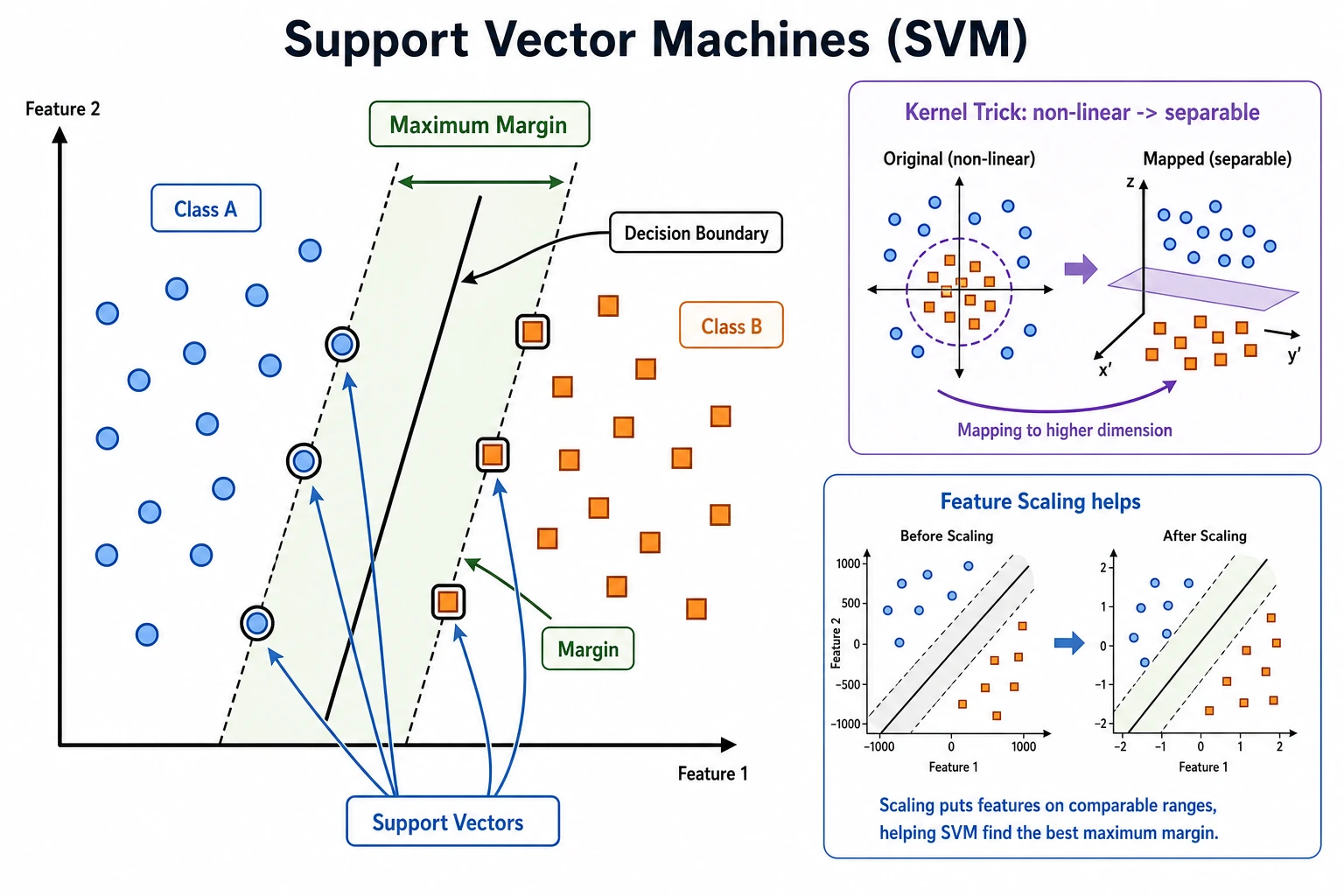
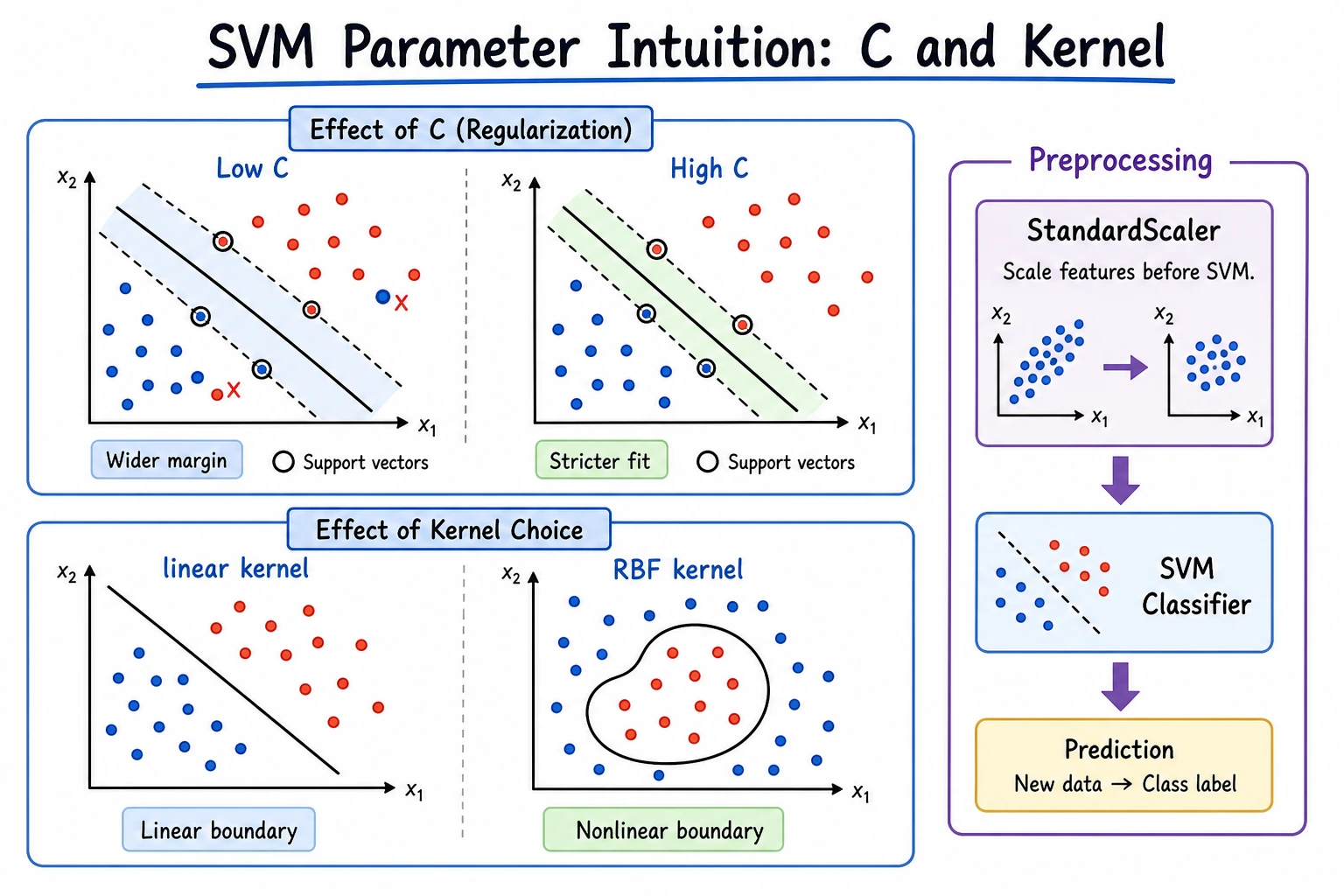
SVM tries to find a decision boundary with a large margin. The points closest to the boundary are the support vectors; they are the samples that most strongly shape the boundary.
What You Need
- Python 3.10+
- Current stable
scikit-learnandnumpy
python -m pip install -U scikit-learn numpy
Key Terms
- Margin: distance between the boundary and the nearest samples.
- Support vector: a critical sample near the boundary.
C: controls tolerance for mistakes. LargerCusually fits training data more tightly.- Kernel: controls whether the boundary is linear or nonlinear.
- Scaling: SVM usually needs normalized feature ranges.
Run A Linear SVM Baseline
Create svm_baseline.py:
import numpy as np
from sklearn.pipeline import make_pipeline
from sklearn.preprocessing import StandardScaler
from sklearn.svm import SVC

X = np.array([
    [1.0, 1.2],
    [1.3, 0.9],
    [1.1, 1.0],
    [4.0, 4.2],
    [4.3, 3.8],
    [3.9, 4.1],
])
y = np.array([0, 0, 0, 1, 1, 1])

model = make_pipeline(
    StandardScaler(),
    SVC(kernel="linear", C=1.0),
)

model.fit(X, y)
pred = model.predict([[1.2, 1.1], [4.2, 4.0]])
svc = model.named_steps["svc"]

print("predictions:", pred.tolist())
print("support_per_class:", svc.n_support_.tolist())
Run it:
python svm_baseline.py
Expected output:
predictions: [0, 1]
support_per_class: [2, 1]
This is the smallest useful SVM habit: scale features, fit the model, predict, then inspect support vectors.
Change The Boundary
Run this standalone comparison:
from sklearn.svm import SVC

for kernel in ["linear", "rbf"]:
    if kernel == "linear":
        model = SVC(kernel="linear", C=1.0)
    else:
        model = SVC(kernel="rbf", C=1.0, gamma="scale")
    print(model)
Expected output starts like:
SVC(kernel='linear')
SVC()
Use linear first when the boundary is simple. Try rbf when the boundary is visibly curved or linear SVM underfits.
Practical Rule
Try SVM when:
- The dataset is small or medium.
- Features are already meaningful.
- The class boundary is reasonably clear.
- You need a strong baseline before heavier models.
Be careful when the dataset is very large or prediction latency must be extremely low.
Common Mistakes
- Forgetting
StandardScaler(). - Starting with a complex kernel before trying linear.
- Tuning
Cand kernel before checking feature quality.
Practice
Add two noisy points near the boundary and compare C=0.1, C=1.0, and C=10.0. Record how many support vectors each version uses.