E.0 Elective Hands-on Workshop

This workshop is the shortest way to feel what the electives are for. You will run one Python script and inspect the evidence files it creates.
What you will build
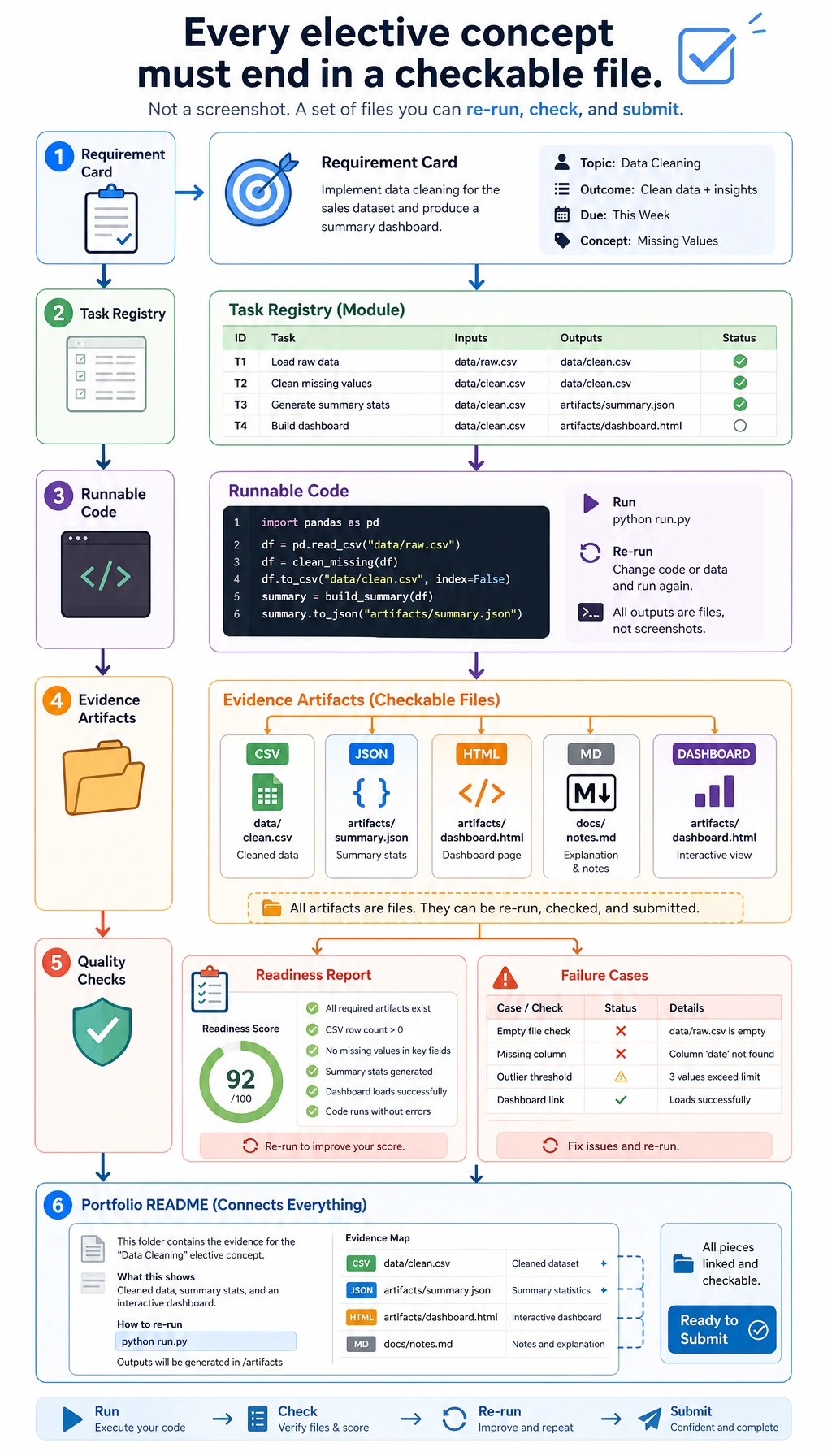
The script creates this folder:
elective_workshop_run/
  outputs/module_a_deployment_score.csv
  outputs/module_b_python_trace.json
  outputs/module_c_knn_predictions.csv
  outputs/module_d_red_team_report.md
  outputs/module_e_dashboard.html
  outputs/module_f_product_canvas.md
  reports/failure_cases.md
  reports/readiness_score.json
  README.md
Each file maps to one elective:
| Module | Skill | Evidence file |
|---|---|---|
| A | deployment trade-off | deployment score CSV |
| B | Python engineering trace | JSON trace |
| C | classic ML baseline | KNN prediction CSV |
| D | safety regression | red-team Markdown report |
| E | frontend evidence | static HTML dashboard |
| F | product judgment | product priority Markdown table |
Run the workshop
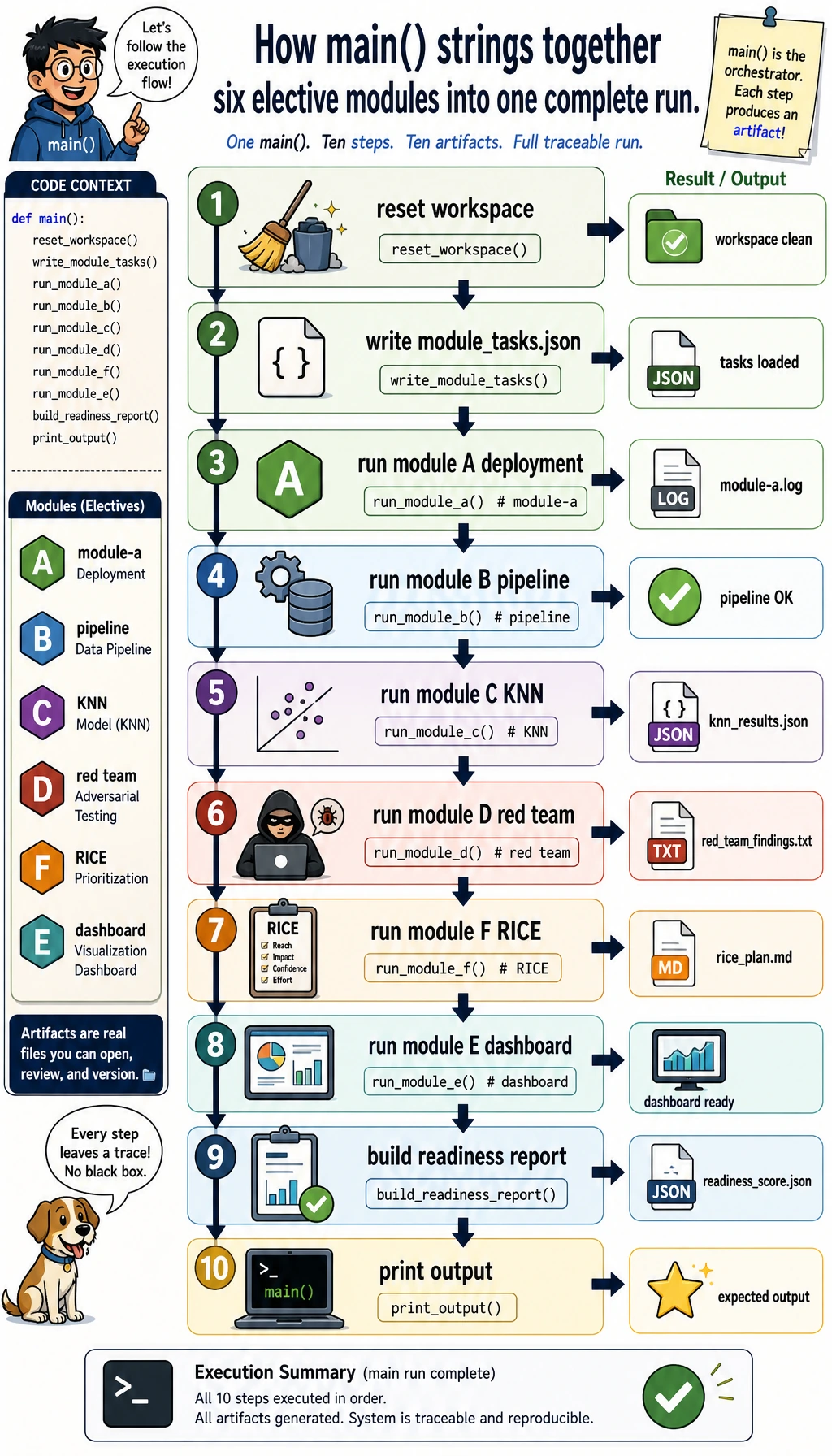
Create a clean folder:
mkdir elective-workshop
cd elective-workshop
Create elective_workshop.py:
elective_workshop.py
from pathlib import Path
import csv
import html
import json
import math
import shutil

RUN = Path("elective_workshop_run")
OUT = RUN / "outputs"
REPORTS = RUN / "reports"


def reset():
    if RUN.exists():
        shutil.rmtree(RUN)
    OUT.mkdir(parents=True)
    REPORTS.mkdir(parents=True)


def write_json(path, data):
    path.write_text(json.dumps(data, indent=2, ensure_ascii=False), encoding="utf-8")


def write_csv(path, rows):
    with path.open("w", newline="", encoding="utf-8") as f:
        writer = csv.DictWriter(f, fieldnames=list(rows[0]))
        writer.writeheader()
        writer.writerows(rows)


def write_md_table(path, headers, rows):
    lines = ["| " + " | ".join(headers) + " |", "|" + "|".join(["---"] * len(headers)) + "|"]
    lines += ["| " + " | ".join(map(str, row)) + " |" for row in rows]
    path.write_text("\n".join(lines) + "\n", encoding="utf-8")


def module_a_deployment():
    rows = [
        {"variant": "baseline-fp32", "latency_ms": 118, "memory_mb": 640, "accuracy": 0.912},
        {"variant": "quantized-int8", "latency_ms": 54, "memory_mb": 310, "accuracy": 0.901},
        {"variant": "distilled-small", "latency_ms": 43, "memory_mb": 220, "accuracy": 0.872},
    ]
    for row in rows:
        latency_score = min(80 / row["latency_ms"], 1.2) * 35
        memory_score = min(450 / row["memory_mb"], 1.2) * 20
        accuracy_score = max(0, (row["accuracy"] - 0.89) / 0.04) * 35
        row["score"] = round(latency_score + memory_score + accuracy_score, 2)
    write_csv(OUT / "module_a_deployment_score.csv", rows)
    return max(rows, key=lambda row: row["score"])


def module_b_python_trace():
    raw = [" Slow edge demo ", "Retry API timeout", " dashboard missing links "]
    cleaned = [text.strip().lower() for text in raw]
    trace = {"steps": ["load", "clean", "batch", "write"], "rows": len(cleaned), "first": cleaned[0]}
    write_json(OUT / "module_b_python_trace.json", trace)
    return trace


def distance(a, b):
    return math.sqrt(sum((x - y) ** 2 for x, y in zip(a, b)))


def module_c_knn():
    train = [([0.1, 0.2], "low"), ([0.8, 0.9], "high"), ([0.5, 0.45], "review")]
    tests = [([0.12, 0.18], "low"), ([0.82, 0.85], "high"), ([0.48, 0.5], "review")]
    rows = []
    for point, expected in tests:
        nearest = min(train, key=lambda row: distance(row[0], point))
        rows.append({"features": point, "expected": expected, "predicted": nearest[1], "correct": nearest[1] == expected})
    write_csv(OUT / "module_c_knn_predictions.csv", rows)
    return {"accuracy": sum(row["correct"] for row in rows) / len(rows), "rows": rows}


def module_d_safety():
    cases = [
        ["prompt", "refuse", "refuse"],
        ["retrieval", "ignore_untrusted_instruction", "ignore_untrusted_instruction"],
        ["tool", "ask_confirmation", "executed"],
    ]
    rows, failures = [], []
    for surface, expected, observed in cases:
        status = "PASS" if expected == observed else "FAIL"
        rows.append([surface, expected, observed, status])
        if status == "FAIL":
            failures.append(surface)
    write_md_table(OUT / "module_d_red_team_report.md", ["surface", "expected", "observed", "status"], rows)
    (REPORTS / "failure_cases.md").write_text("\n".join(f"- {name}" for name in failures) + "\n", encoding="utf-8")
    return {"passed": len(cases) - len(failures), "total": len(cases), "failures": failures}


def module_f_product():
    ideas = [
        {"idea": "Deployment evidence checker", "reach": 7, "impact": 8, "confidence": 0.8, "effort": 3},
        {"idea": "Async batch runner", "reach": 5, "impact": 7, "confidence": 0.65, "effort": 4},
        {"idea": "Red-team regression gate", "reach": 6, "impact": 9, "confidence": 0.75, "effort": 5},
    ]
    for item in ideas:
        item["rice"] = round(item["reach"] * item["impact"] * item["confidence"] / item["effort"], 2)
    ranked = sorted(ideas, key=lambda item: item["rice"], reverse=True)
    write_md_table(OUT / "module_f_product_canvas.md", list(ranked[0]), [item.values() for item in ranked])
    return ranked[0]


def module_e_dashboard(summary):
    cards = "".join(
        f"<section><h2>{html.escape(k)}</h2><pre>{html.escape(json.dumps(v, ensure_ascii=False, indent=2))}</pre></section>"
        for k, v in summary.items()
    )
    page = f"""<!doctype html><html lang='en'><meta charset='utf-8'><title>Elective Workshop</title>
<style>body{{font-family:system-ui,sans-serif;max-width:900px;margin:32px auto;background:#f8fafc}}section{{background:white;border:1px solid #ddd;border-radius:8px;padding:16px;margin:12px 0}}pre{{white-space:pre-wrap}}</style>
<h1>Elective Workshop Evidence</h1>{cards}</html>"""
    (OUT / "module_e_dashboard.html").write_text(page, encoding="utf-8")
    return {"cards": len(summary)}


def main():
    reset()
    summary = {
        "module_a": module_a_deployment(),
        "module_b": module_b_python_trace(),
        "module_c": module_c_knn(),
        "module_d": module_d_safety(),
        "module_f": module_f_product(),
    }
    summary["module_e"] = module_e_dashboard(summary)
    readiness = round(
        (summary["module_c"]["accuracy"] * 100 + summary["module_d"]["passed"] / summary["module_d"]["total"] * 100 + summary["module_a"]["score"]) / 3,
        1,
    )
    write_json(REPORTS / "readiness_score.json", {"readiness_score": readiness, "summary": summary})
    (RUN / "README.md").write_text("# Elective Workshop Evidence Pack\n\nRun `python elective_workshop.py`, then inspect `outputs/` and `reports/`.\n", encoding="utf-8")

    print("modules: 6")
    print("best_deployment:", summary["module_a"]["variant"])
    print("knn_accuracy:", f"{summary['module_c']['accuracy']:.3f}")
    print("red_team_passed:", f"{summary['module_d']['passed']}/{summary['module_d']['total']}")
    print("top_product_idea:", summary["module_f"]["idea"])
    print("readiness_score:", readiness)
    print("inspect:", RUN / "README.md")


if __name__ == "__main__":
    main()
Run it:
python3 elective_workshop.py
Expected output:
modules: 6
best_deployment: quantized-int8
knn_accuracy: 1.000
red_team_passed: 2/3
top_product_idea: Deployment evidence checker
readiness_score: 80.8
inspect: elective_workshop_run/README.md
Inspect the results
| File | What to check |
|---|---|
outputs/module_a_deployment_score.csv | Why quantized-int8 wins: latency and memory improve while accuracy stays above the floor |
outputs/module_b_python_trace.json | The pipeline has visible steps instead of hidden work |
outputs/module_c_knn_predictions.csv | A tiny classic ML baseline predicts all test rows correctly |
outputs/module_d_red_team_report.md | The tool case intentionally fails and becomes a regression case |
outputs/module_e_dashboard.html | The evidence is readable in a browser |
outputs/module_f_product_canvas.md | RICE turns product priority into explicit numbers |
Debug quickly
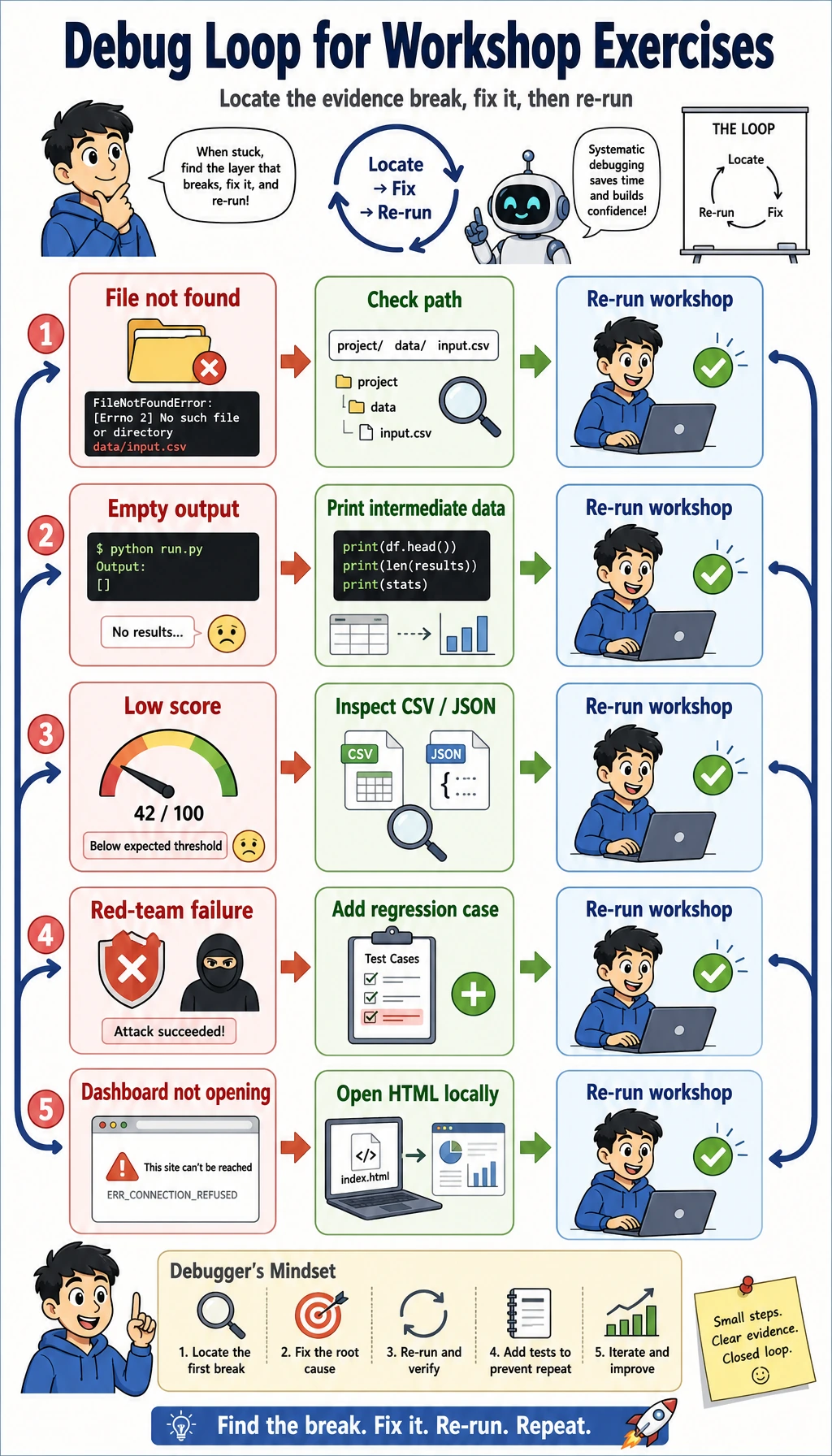
| Symptom | First fix |
|---|---|
python3 not found | Try python --version, then run python elective_workshop.py if it is Python 3 |
| No output folder | Run pwd and confirm you are in the workshop folder |
| CSV looks wrong | Print rows before write_csv(...) |
| Red-team failure appears | This is intentional; change observed from executed to ask_confirmation and rerun |
| HTML does not open | Open elective_workshop_run/outputs/module_e_dashboard.html directly |
Turn it into your project
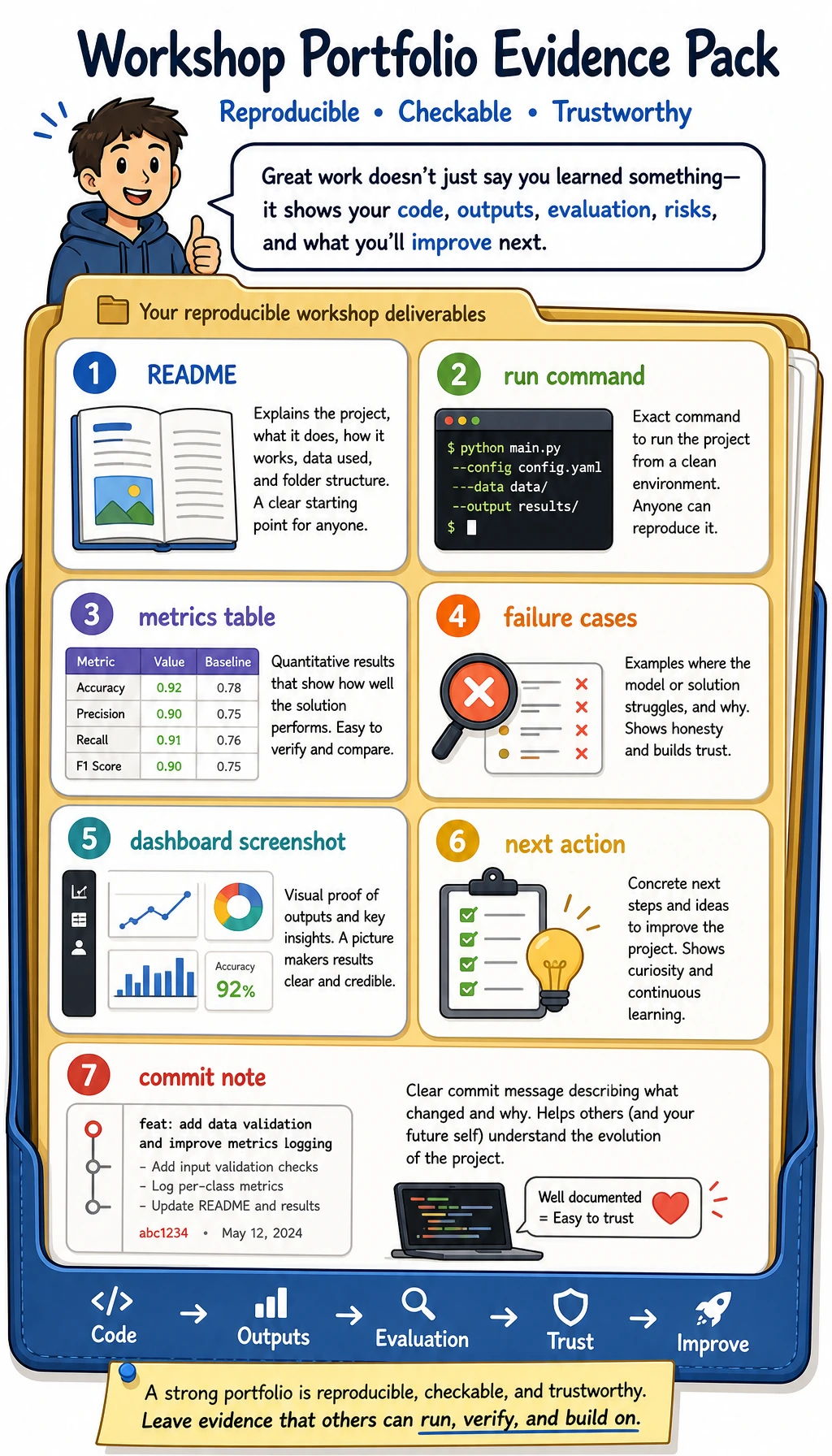
Replace one module with real evidence:
- Module A: real latency, memory, and accuracy.
- Module B: real pipeline trace.
- Module C: your dataset and baseline.
- Module D: your safety cases.
- Module E: your dashboard or screenshot.
- Module F: your product ideas and RICE scores.
You are done when another person can run one command, inspect the files, understand one failure, and see the next action.