E.B.2 Advanced Iterators and Generators
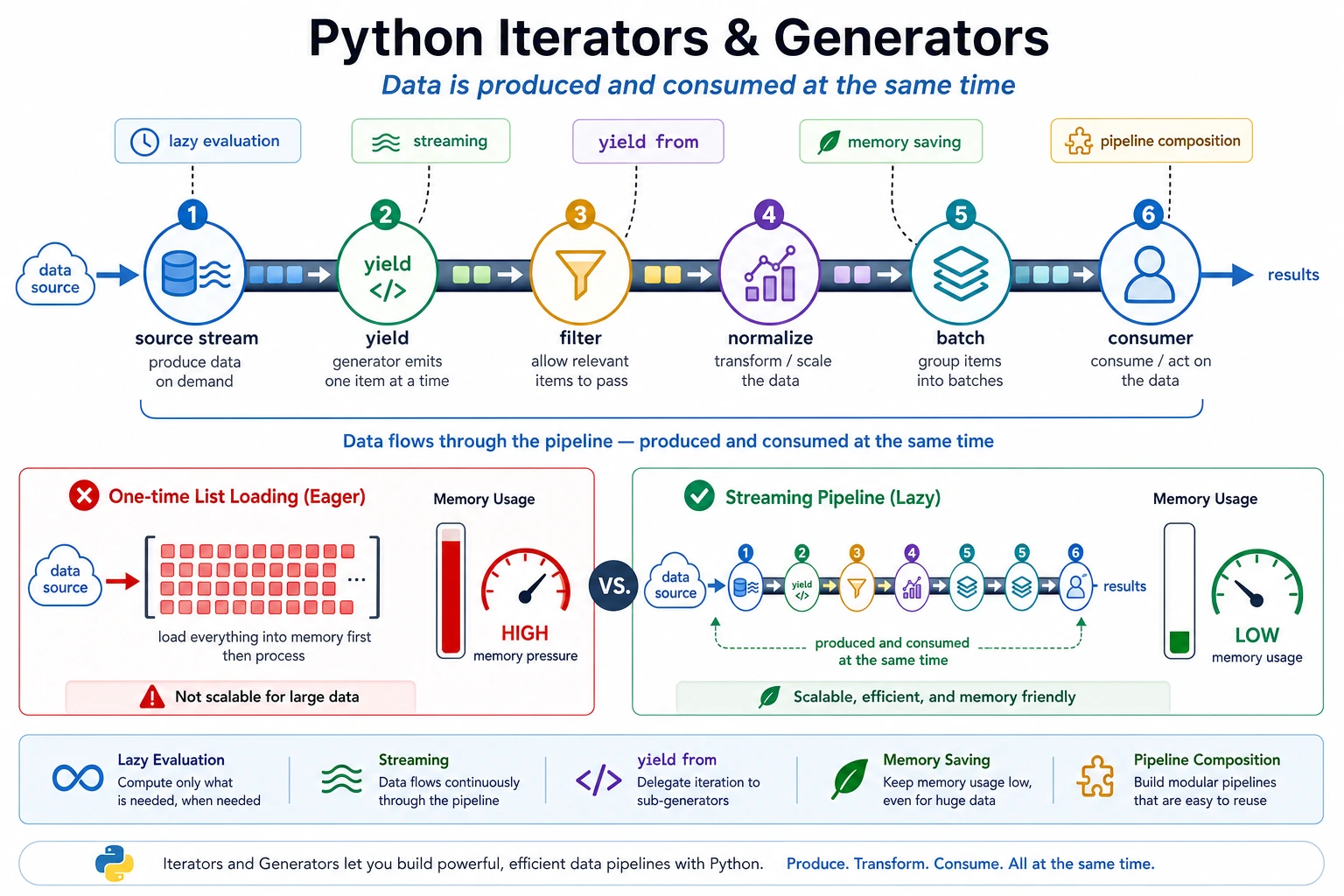
Generators are useful when data arrives as a stream: logs, files, API pages, sample batches, retrieval results, or model outputs. They produce one item at a time, so you avoid building unnecessary intermediate lists.
What You Need
- Python 3.10+
- No external packages
- Basic understanding of
forloops
Key Terms
- Iterator: an object that can produce the next value.
- Generator: a function that uses
yieldto produce values lazily. - Lazy evaluation: compute the next value only when needed.
- Pipeline: small processing steps chained together.
yield from: forward values from another iterable.
Run A Streaming Pipeline
Create generator_pipeline.py:
def read_events():
    events = [
        "INFO request ok",
        "ERROR db timeout",
        "INFO cache hit",
        "ERROR auth failed",
        "ERROR model busy",
    ]
    for event in events:
        yield event


def filter_errors(events):
    for event in events:
        if event.startswith("ERROR"):
            yield event


def normalize(events):
    for event in events:
        yield event.lower()


def batch(items, size):
    group = []
    for item in items:
        group.append(item)
        if len(group) == size:
            yield group
            group = []
    if group:
        yield group


pipeline = batch(normalize(filter_errors(read_events())), size=2)

for group in pipeline:
    print(group)
Run it:
python generator_pipeline.py
Expected output:
['error db timeout', 'error auth failed']
['error model busy']
The pipeline reads, filters, normalizes, and batches without creating a full list at every step.
Use yield from
Run this small standalone demo:
def flatten(groups):
    for group in groups:
        yield from group

pipeline = [
    ["error db timeout", "error auth failed"],
    ["error model busy"],
]

for item in flatten(pipeline):
    print(item)
Expected output:
error db timeout
error auth failed
error model busy
This expresses “send every item inside each group outward” more clearly than a nested loop.
When Generators Help
Use generators when:
- The input may be large.
- You process records one by one.
- You want to connect read/filter/transform/batch steps.
- You do not need random access to all items.
Prefer a list when the data is small and repeated access makes the code simpler.
Common Mistakes
- Expecting a generator to be reusable after it has been consumed.
- Assuming generators are always faster; their main benefit is often memory and structure.
- Making a simple list transformation harder to read by forcing
yieldeverywhere.
Practice
Modify batch so it also prints batch_id. Then change the input events and confirm the pipeline still works without changing the later steps.