E.A.2 Advanced C++
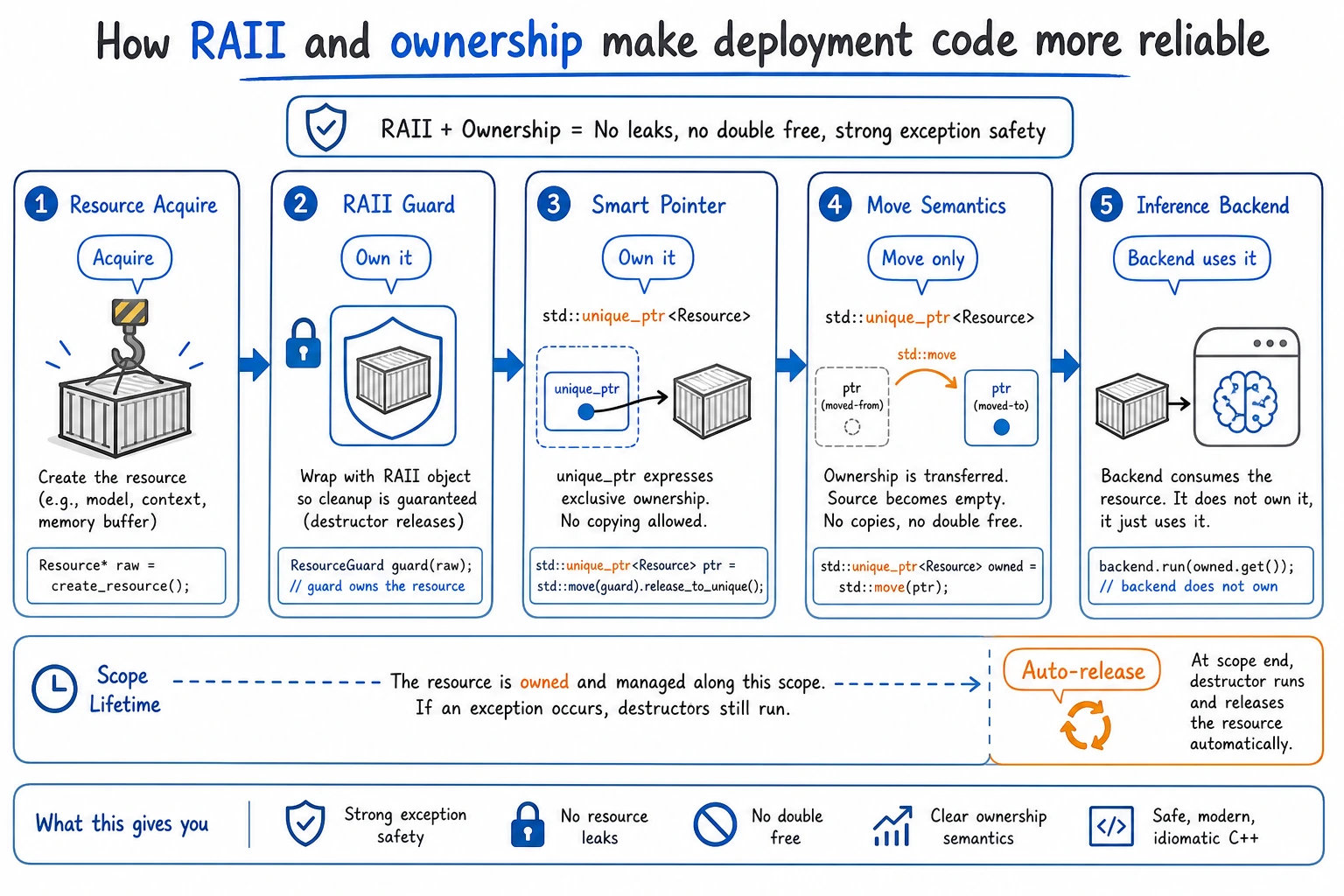
Advanced C++ in deployment is mostly about one question: who owns the resource, and when is it released?
Run an ownership and interface example
Create advanced.cpp:
#include <iostream>
#include <memory>

struct Engine {
    virtual ~Engine() = default;
    virtual float run(float input) = 0;
};

struct CpuEngine : Engine {
    float run(float input) override {
        return input * 0.84f;
    }
};

class Session {
public:
    explicit Session(std::unique_ptr<Engine> engine)
        : engine_(std::move(engine)) {}

    void predict() {
        std::cout << "cpu_score=" << engine_->run(1.0f) << "\n";
        std::cout << "session_done\n";
    }

private:
    std::unique_ptr<Engine> engine_;
};

int main() {
    Session session(std::make_unique<CpuEngine>());
    session.predict();
    return 0;
}
Run it:
c++ -std=c++17 advanced.cpp -o advanced
./advanced
Expected output:
cpu_score=0.84
session_done
What to notice
| C++ idea | Deployment meaning |
|---|---|
Engine interface | Business code can switch CPU/GPU/runtime backends |
std::unique_ptr | Only one owner controls the engine resource |
std::move | Ownership is transferred into Session |
destructor through virtual ~Engine() | Cleanup is safe through the interface |
| RAII | Resource lifetime follows object lifetime |
Practice change
Add a second engine:
struct FastEngine : Engine {
    float run(float input) override {
        return input * 0.91f;
    }
};
Then replace CpuEngine with FastEngine. The rest of Session should not change.
Pass check
You pass this lesson when you can explain why Session owns the engine, why unique_ptr is safer than a raw pointer here, and how an interface lets one deployment path swap runtime backends.