7.8.3 Project: Deliverables Kit
The last step in an LLM project is not just “it runs.”
It is:
Can another person understand the goal, reproduce the result, inspect the evaluation, and continue from where you stopped?
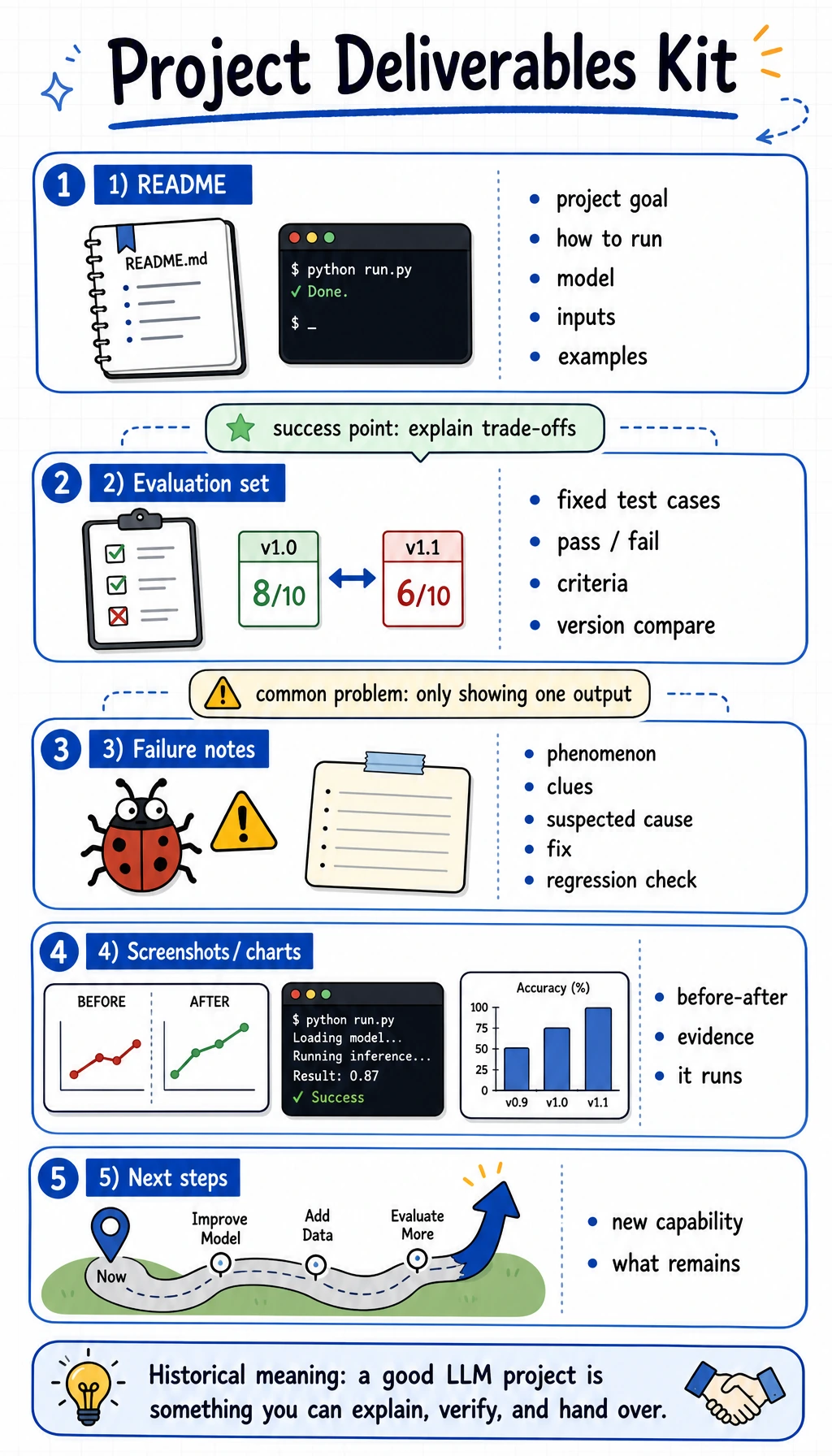
Many projects fail the portfolio test not because the model is weak, but because the final handoff is weak. A good project needs evidence, not just a demo.
What should be in the final package?
At minimum, a good LLM project package should include:
README.md- one reproducible run command
- example inputs and outputs
- evaluation records
- one failure case analysis
- screenshots or charts
- a next-step plan
This is the smallest set that lets the project stand on its own.
The folder structure that makes review easy
project/
├── README.md
├── examples/
│   ├── input-01.json
│   └── output-01.json
├── reports/
│   ├── evaluation.md
│   └── failure_cases.md
├── screenshots/
│   ├── run-01.png
│   └── before-after.png
└── src/
    └── ...
This structure is simple on purpose:
README.mdtells the storyexamples/proves the taskreports/proves the evaluationscreenshots/proves the project runs
A README template you can reuse
Copy this outline and fill it with your own project content.
# Project Name

## 1. Goal
What problem does this project solve?

## 2. Task Scope
What is in scope and what is not?

## 3. Baseline
What is the simplest method you compared against?

## 4. Data
Where did the data come from? How many samples?

## 5. Evaluation
What metrics or manual checks did you use?

## 6. Results
What improved? What still failed?

## 7. Failure Cases
Show one real failure and explain the cause.

## 8. Run Instructions
How do I reproduce the result?

## 9. Next Steps
What would you improve next?
A simple evaluation record template
If your project has a fixed test set, keep the results in a small table like this:
| Case ID | Input | Baseline | New Method | Pass? | Note |
|---|---|---|---|---|---|
| 001 | Refund request | Generic answer | Domain-aware answer | Yes | Covers policy points |
| 002 | Address change | Too vague | Clear rule-based reply | Yes | Better structure |
| 003 | Invoice question | Misses key detail | Correct answer | No | Need more data |
This makes it easy to compare versions later.
A failure note template that is actually useful
Do not just write “the model is bad.”
Write a note like this:
# Failure Case: Missing JSON field

- Phenomenon: The output sometimes adds extra text before the JSON object.
- Clues: This happens more often on long prompts.
- Suspected cause: The prompt does not strongly constrain the output format.
- Investigation: Compare prompt versions and inspect the raw outputs.
- Fix action: Add a strict schema reminder and a short example.
- Regression check: Run the same fixed test cases again.
That one note is often more valuable than ten screenshots.
What a strong project handoff looks like
The handoff should let another person answer three questions quickly:
- What problem does this project solve?
- How do I reproduce it?
- Why is the solution better than the baseline?
If those three questions are easy to answer, the project is ready for a portfolio or a team review.
Final checklist
Before you close the project, check these items:
- README explains the goal and scope
- run command works
- baseline and new method are both shown
- evaluation set is fixed
- at least one failure case is included
- screenshots or charts are present
- next-step plan is written
Summary
A good LLM project is not just a working script.
It is a package that can be understood, reproduced, evaluated, and extended.
When you can do that, you are no longer just learning techniques. You are building something other people can actually use.