6.8.5 Hands-on Workshop: Build a PyTorch Training Evidence Pack
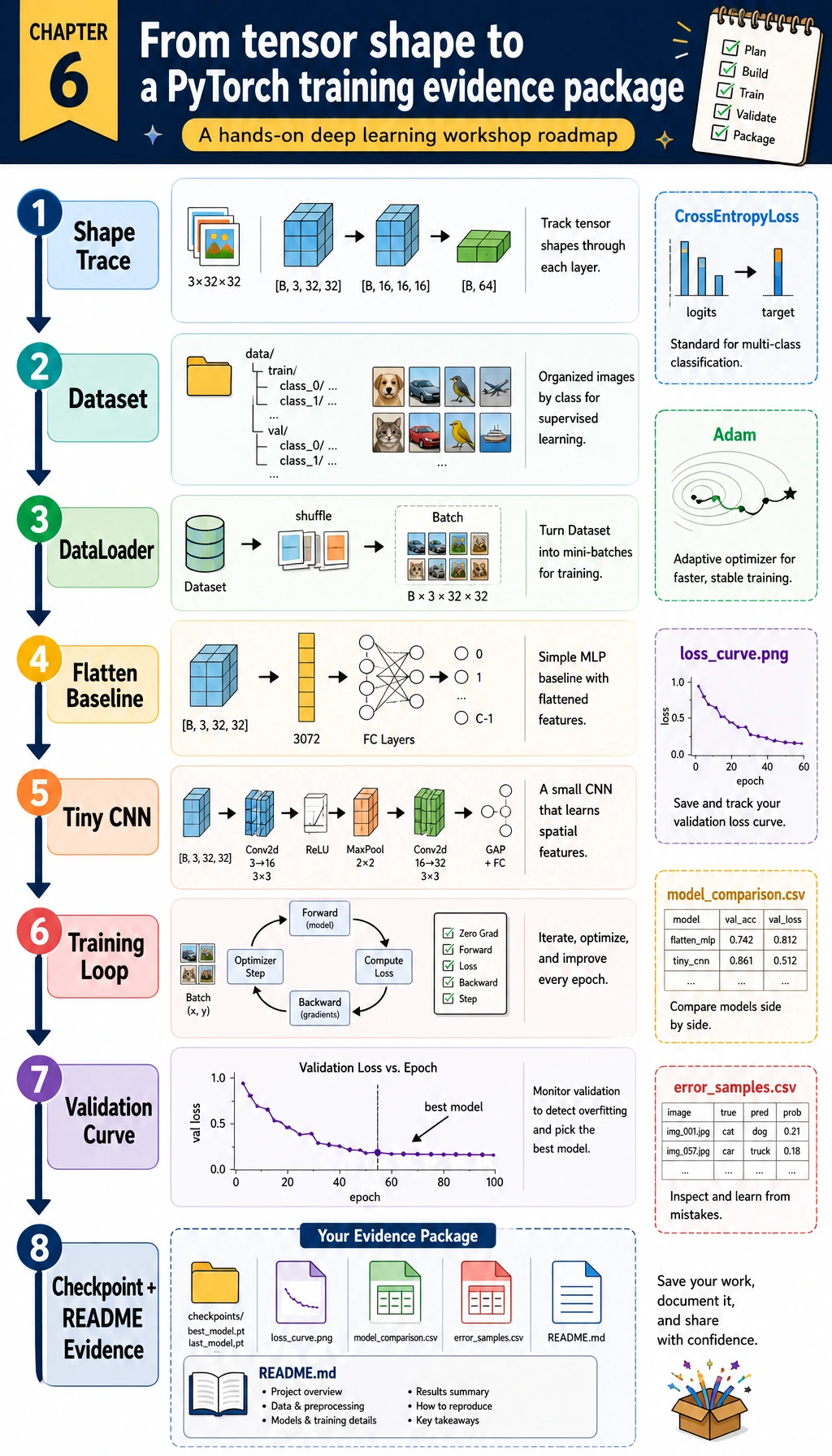
Read the diagram first, then run the code. The goal is not to train a big model. The goal is to practice the complete Chapter 6 loop: shape check, Dataset, DataLoader, nn.Module, training loop, validation loop, checkpoint, loss curve, error review, and README evidence.
Learning Objectives
- Build a tiny image classification dataset locally without downloads
- Compare a simple
Flatten + Linearbaseline with a small CNN - Use
Dataset,DataLoader,nn.Module, loss, optimizer, and validation correctly - Save training logs, model comparison, confusion matrix, review samples, a loss curve, and a checkpoint
- Explain common deep learning failures: shape mismatch, loss not decreasing, overfitting, and memory pressure
What You Will Build
This workshop creates a local folder called deep_learning_workshop_run/.
The task is:
Classify small synthetic 16x16 grayscale images into vertical stripe, horizontal stripe, or diagonal stripe.
The dataset is generated by code. That keeps the exercise runnable on CPU, avoids dataset downloads, and still lets you practice the same engineering habits used in real image and text projects.
| Chapter 6 idea | What you will do in the project |
|---|---|
| Tensor shape | Trace (batch, channel, height, width) before training |
| Dataset | Wrap images, labels, and sample ids in a custom Dataset |
| DataLoader | Batch and shuffle the training data |
| Baseline | Train a Flatten + Linear model first |
| CNN | Train a small convolutional network |
| Training loop | Run zero_grad -> forward -> loss -> backward -> step |
| Validation | Choose the best model with validation accuracy |
| Evidence | Save logs, curves, errors, checkpoint, and README |
Mental Model: One Image, One Batch, Three Splits
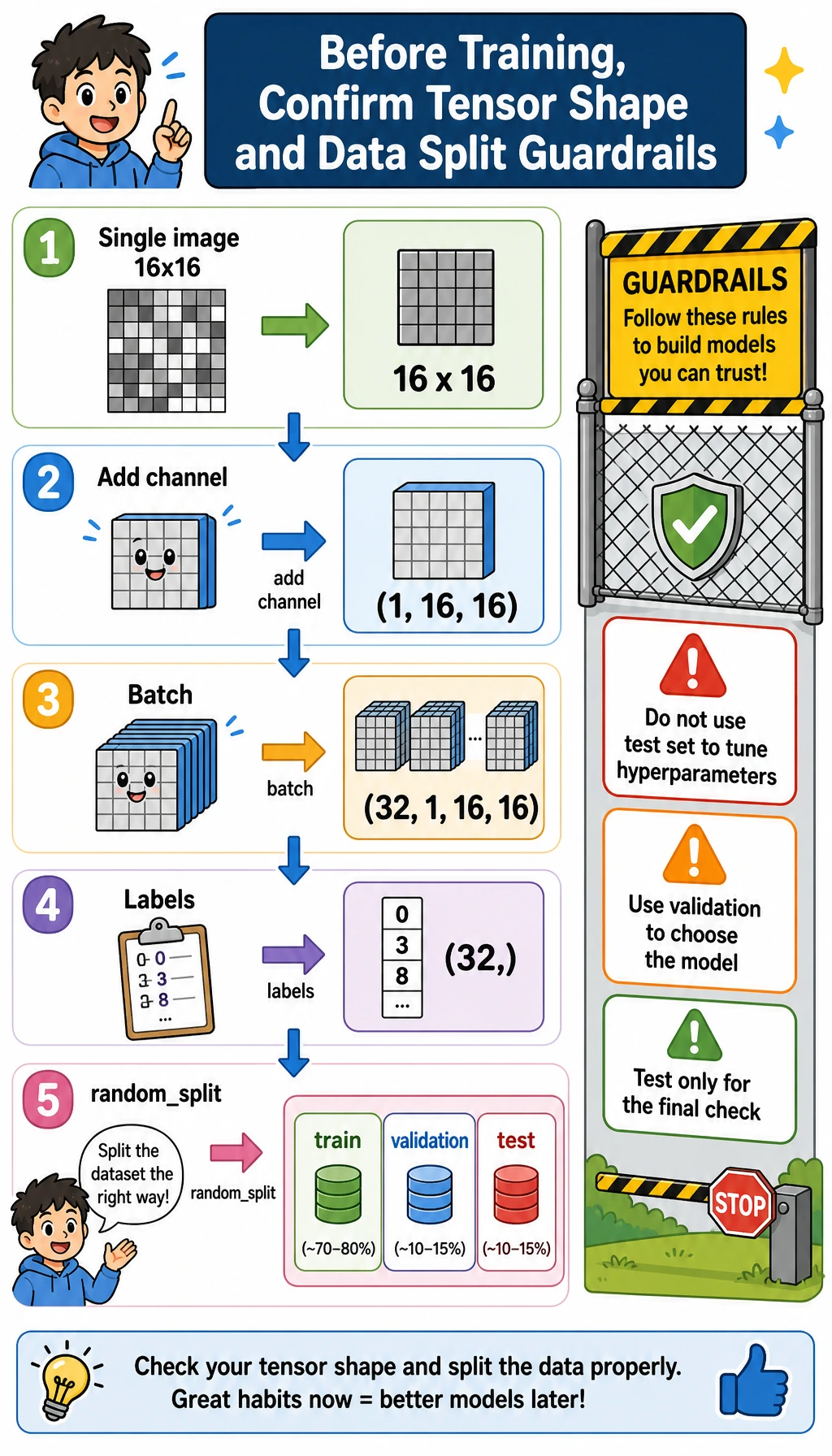
Before you run the script, keep this map in your head:
- One generated image is a tensor with shape
(1, 16, 16): one grayscale channel, height 16, width 16. - A mini-batch becomes
(32, 1, 16, 16): 32 images processed together. - The label batch is
(32,): one integer class id for each image. train_setteaches the model,val_setchooses between models, andtest_setis held back for the final score.
The split matters. If you tune learning rate, epochs, or model width by repeatedly looking at the test set, the test score stops being honest. This small workshop uses random_split with a fixed seed so you can rerun it and get the same teaching evidence.
Evidence Flow: From Training Run to Report
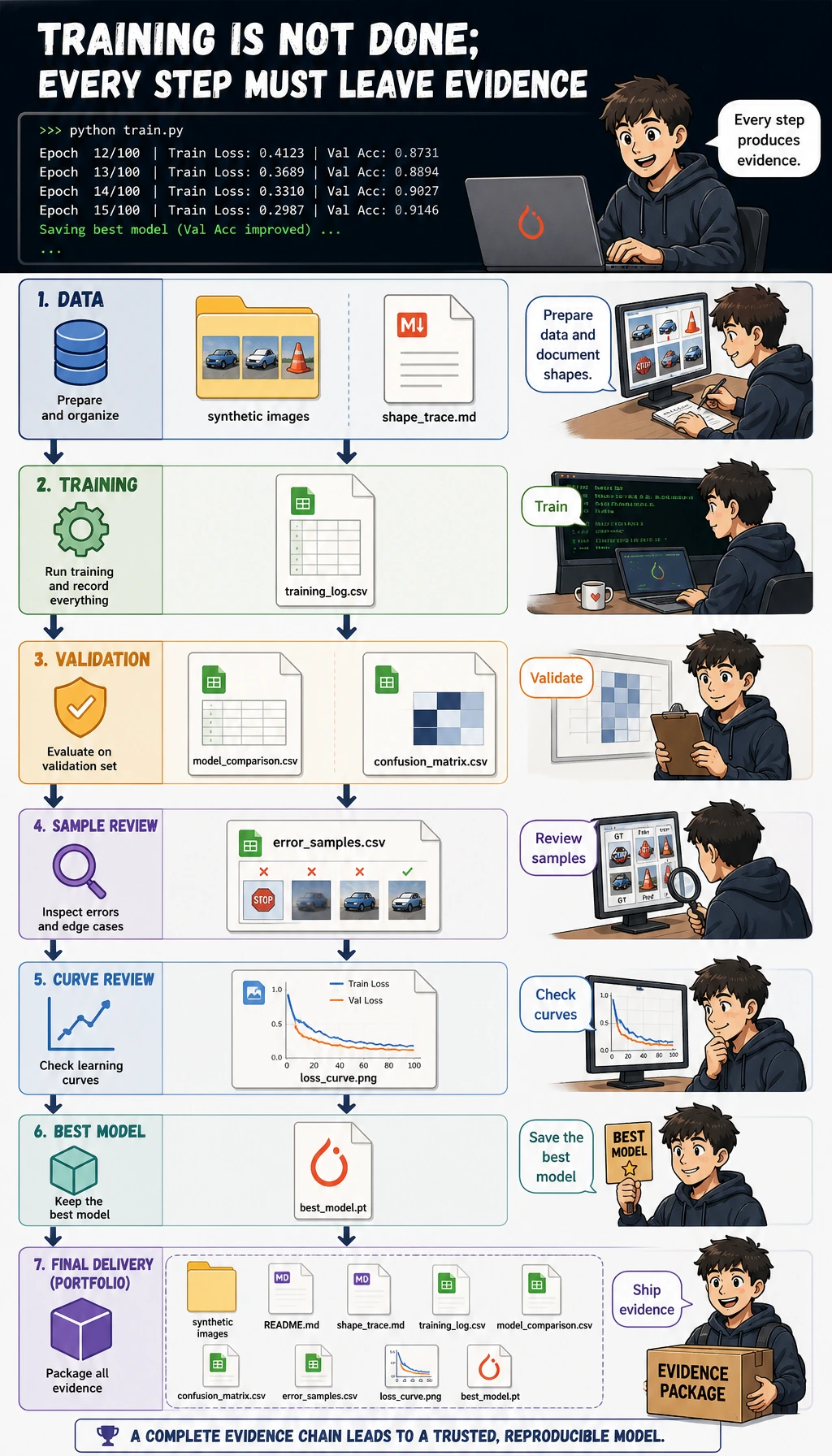
A beginner mistake is stopping at:
loss.backward()
optimizer.step()
print("done")
That does not prove the training process is healthy. A usable deep learning project should answer:
- What shapes entered the model?
- Did the loss actually decrease?
- Did validation improve, or only training?
- Which model beat the baseline?
- Which samples should be reviewed?
- Can someone rerun the project from a clean folder?
The script below creates this evidence pack:
deep_learning_workshop_run/
  outputs/training_log.csv
  outputs/model_comparison.csv
  outputs/confusion_matrix.csv
  outputs/error_samples.csv
  outputs/metrics_summary.json
  curves/loss_curve.png
  checkpoints/best_model.pt
  reports/shape_trace.md
  reports/debug_checklist.md
  README.md
Terms to Decode Before Running
- Tensor: a multi-dimensional array. In this workshop, one image batch has shape
(batch, channel, height, width). - Logits: raw model outputs before softmax.
CrossEntropyLossexpects logits, not probabilities. - Epoch: one full pass over the training set.
- Validation set: data used to choose a model during development. It is not the same as the final test set.
- Checkpoint: a saved model state that can be loaded later.
- CNN: Convolutional Neural Network, a network that learns local visual patterns with convolution kernels.
- Overfitting: training improves but validation does not; the model is memorizing too much.
Prepare the Environment
Inside this course repository, install the core and AI runtime:
python -m pip install -r requirements-course-core.txt -r requirements-course-ai.txt
If you are working in a separate folder, this workshop only needs PyTorch and Matplotlib:
python -m pip install torch matplotlib
The official PyTorch install page describes the Stable build as the currently tested and supported version. This workshop uses stable PyTorch 2.x core APIs and does not require torchvision, a GPU, or any downloaded dataset. It was verified locally with Python 3.13 and PyTorch 2.11.
Run the Complete Workshop
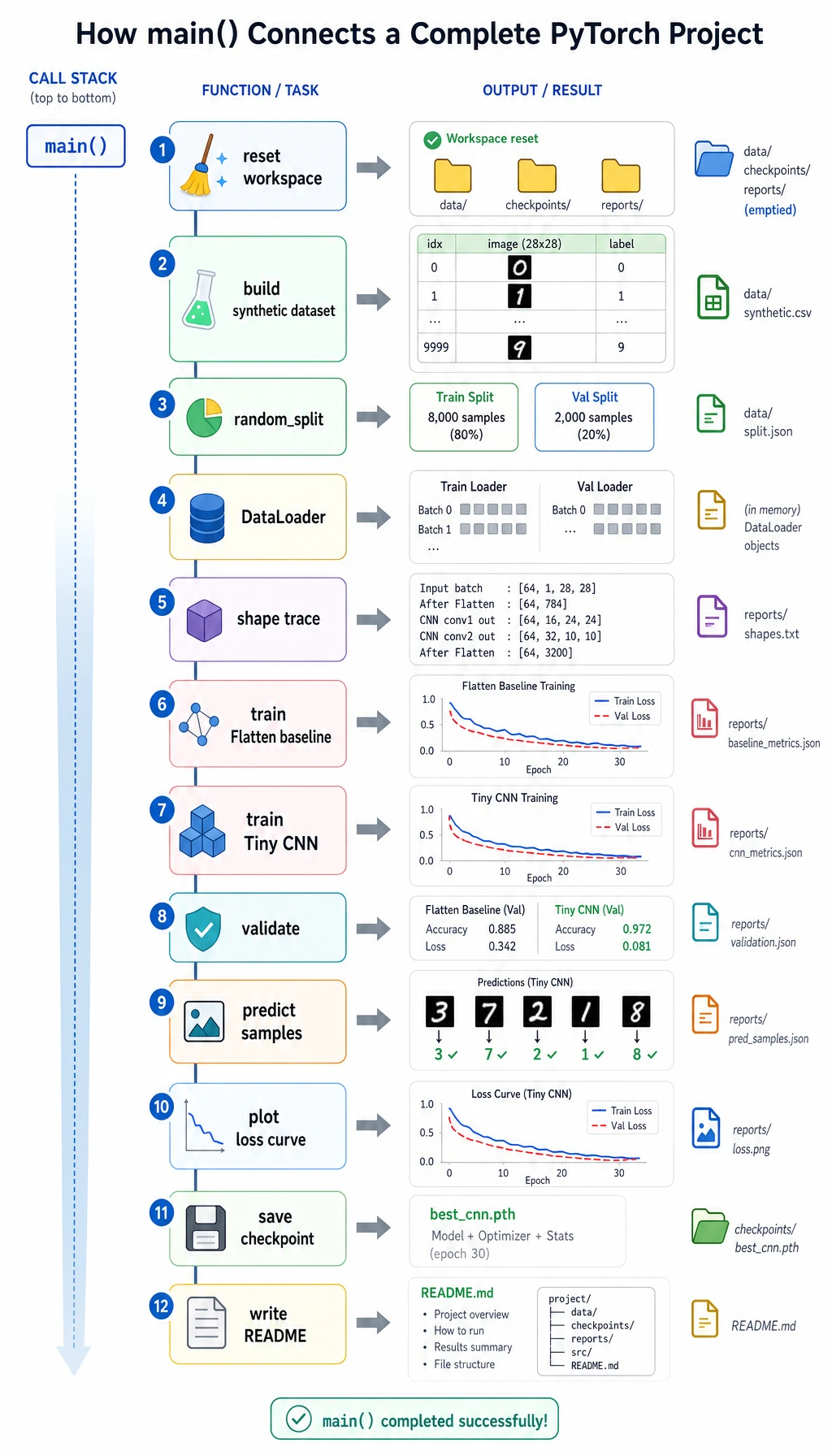
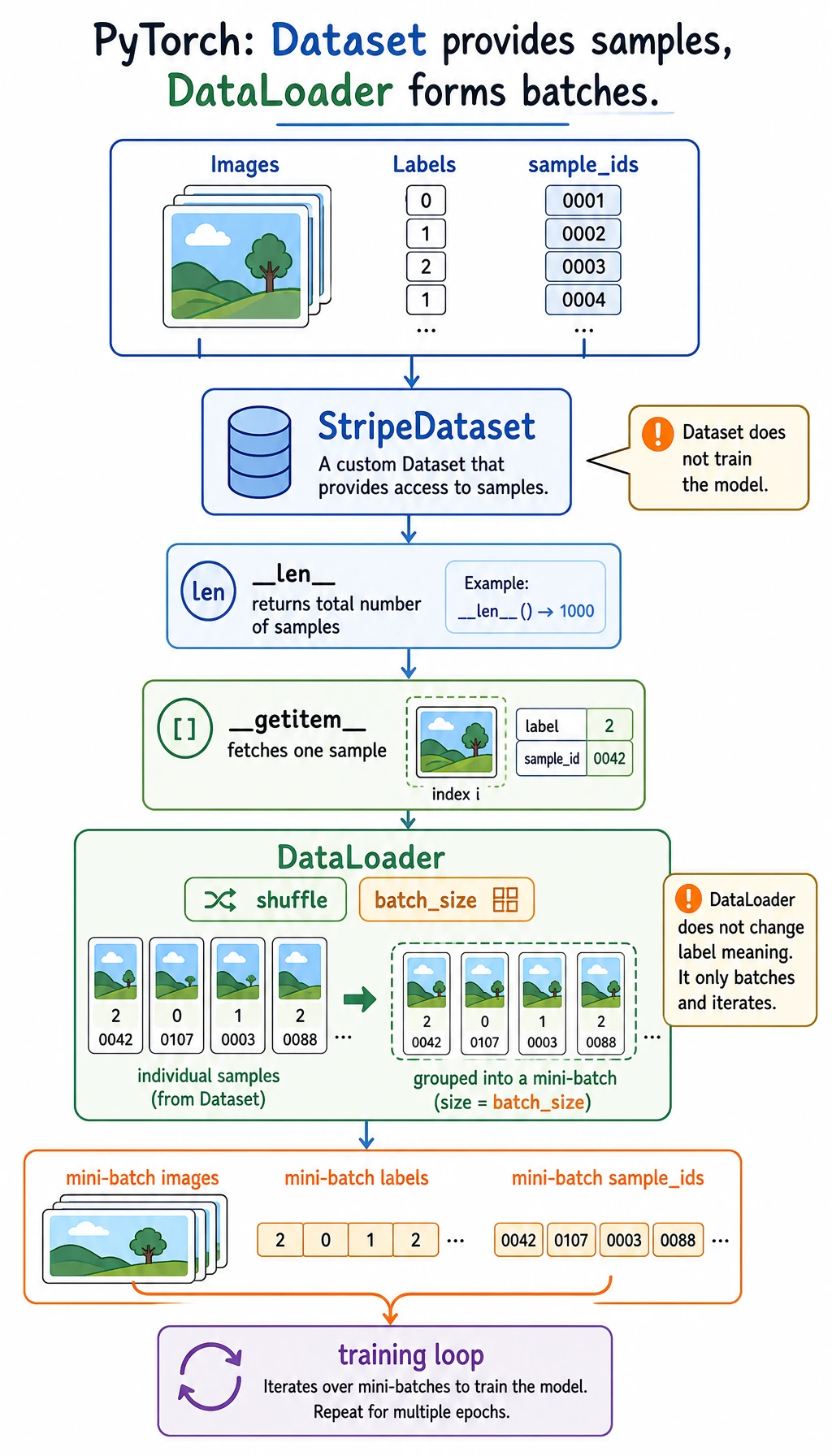
The code has three layers:
StripeDatasetknows how many samples exist and how to return one(image, label, sample_id)record.DataLoaderturns many individual records into shuffled mini-batches.- The training loop consumes those mini-batches and updates model parameters.
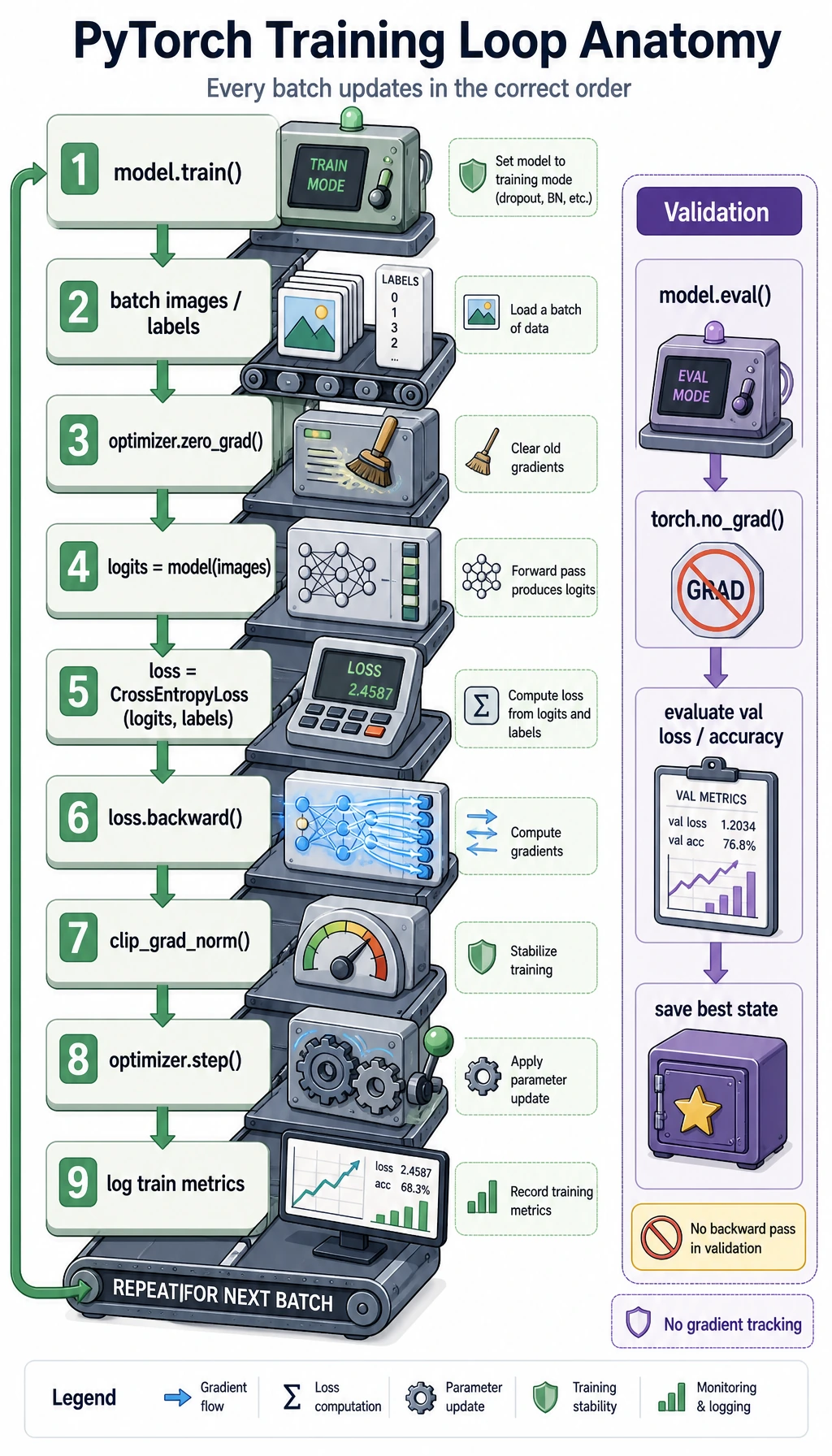
For each training batch, read the loop as an ordered recipe: clear old gradients, run the model, compute loss, backpropagate, clip very large gradients, and step the optimizer. Validation uses model.eval() and torch.no_grad() because it measures the model without changing it.
Create a Clean Folder
mkdir ch06-dl-workshop
cd ch06-dl-workshop
Create dl_workshop.py
Copy the code below into dl_workshop.py.
from __future__ import annotations

import copy
import csv
import json
import math
import shutil
from pathlib import Path

import matplotlib

matplotlib.use("Agg")
import matplotlib.pyplot as plt
import torch
from torch import nn
from torch.utils.data import DataLoader, Dataset, random_split

RUN_DIR = Path("deep_learning_workshop_run")
DATA_DIR = RUN_DIR / "data"
OUTPUT_DIR = RUN_DIR / "outputs"
REPORT_DIR = RUN_DIR / "reports"
CURVE_DIR = RUN_DIR / "curves"
CHECKPOINT_DIR = RUN_DIR / "checkpoints"

CLASSES = ["vertical_stripe", "horizontal_stripe", "diagonal_stripe"]
IMAGE_SIZE = 16
SAMPLES_PER_CLASS = 140
BATCH_SIZE = 32
SEED = 42


def reset_workspace() -> None:
    if RUN_DIR.exists():
        shutil.rmtree(RUN_DIR)
    for folder in (DATA_DIR, OUTPUT_DIR, REPORT_DIR, CURVE_DIR, CHECKPOINT_DIR):
        folder.mkdir(parents=True, exist_ok=True)


class StripeDataset(Dataset):
    def __init__(self, images: torch.Tensor, labels: torch.Tensor, sample_ids: list[str]):
        self.images = images.float()
        self.labels = labels.long()
        self.sample_ids = sample_ids

    def __len__(self) -> int:
        return len(self.labels)

    def __getitem__(self, index: int):
        return self.images[index], self.labels[index], self.sample_ids[index]


def make_stripe_image(label: int, generator: torch.Generator) -> torch.Tensor:
    image = torch.randn((IMAGE_SIZE, IMAGE_SIZE), generator=generator) * 0.20
    if label == 0:
        col = int(torch.randint(1, IMAGE_SIZE - 2, (1,), generator=generator))
        image[:, col : col + 2] += 1.0
    elif label == 1:
        row = int(torch.randint(1, IMAGE_SIZE - 2, (1,), generator=generator))
        image[row : row + 2, :] += 1.0
    else:
        offset = int(torch.randint(-3, 4, (1,), generator=generator))
        for row in range(IMAGE_SIZE):
            col = row + offset
            if 0 <= col < IMAGE_SIZE:
                image[row, col] += 1.1
                if col + 1 < IMAGE_SIZE:
                    image[row, col + 1] += 0.8

    if float(torch.rand((), generator=generator)) < 0.18:
        top = int(torch.randint(0, IMAGE_SIZE - 4, (1,), generator=generator))
        left = int(torch.randint(0, IMAGE_SIZE - 4, (1,), generator=generator))
        image[top : top + 4, left : left + 4] *= 0.25
    return image.clamp(-1.0, 1.5).unsqueeze(0)


def build_dataset(seed: int = SEED) -> StripeDataset:
    generator = torch.Generator().manual_seed(seed)
    images = []
    labels = []
    sample_ids = []
    for label, class_name in enumerate(CLASSES):
        for index in range(SAMPLES_PER_CLASS):
            images.append(make_stripe_image(label, generator))
            labels.append(label)
            sample_ids.append(f"{class_name}_{index:03d}")
    return StripeDataset(torch.stack(images), torch.tensor(labels), sample_ids)


class FlattenBaseline(nn.Module):
    def __init__(self):
        super().__init__()
        self.net = nn.Sequential(nn.Flatten(), nn.Linear(IMAGE_SIZE * IMAGE_SIZE, len(CLASSES)))

    def forward(self, x: torch.Tensor) -> torch.Tensor:
        return self.net(x)


class TinyCNN(nn.Module):
    def __init__(self):
        super().__init__()
        self.features = nn.Sequential(
            nn.Conv2d(1, 8, kernel_size=3, padding=1),
            nn.ReLU(),
            nn.MaxPool2d(2),
            nn.Conv2d(8, 16, kernel_size=3, padding=1),
            nn.ReLU(),
            nn.AdaptiveAvgPool2d((1, 1)),
        )
        self.classifier = nn.Linear(16, len(CLASSES))

    def forward(self, x: torch.Tensor) -> torch.Tensor:
        x = self.features(x)
        x = torch.flatten(x, 1)
        return self.classifier(x)


def evaluate(model: nn.Module, loader: DataLoader, loss_fn: nn.Module) -> tuple[float, float]:
    model.eval()
    total_loss = 0.0
    total_correct = 0
    total_examples = 0
    with torch.no_grad():
        for images, labels, _sample_ids in loader:
            logits = model(images)
            loss = loss_fn(logits, labels)
            total_loss += float(loss.item()) * len(labels)
            total_correct += int((logits.argmax(dim=1) == labels).sum().item())
            total_examples += len(labels)
    return total_loss / total_examples, total_correct / total_examples


def train_model(name: str, model: nn.Module, train_loader: DataLoader, val_loader: DataLoader, *, epochs: int, lr: float):
    loss_fn = nn.CrossEntropyLoss()
    optimizer = torch.optim.Adam(model.parameters(), lr=lr)
    history = []
    best_state = copy.deepcopy(model.state_dict())
    best_val_acc = -math.inf

    for epoch in range(1, epochs + 1):
        model.train()
        total_loss = 0.0
        total_correct = 0
        total_examples = 0
        for images, labels, _sample_ids in train_loader:
            optimizer.zero_grad(set_to_none=True)
            logits = model(images)
            loss = loss_fn(logits, labels)
            loss.backward()
            torch.nn.utils.clip_grad_norm_(model.parameters(), max_norm=2.0)
            optimizer.step()

            total_loss += float(loss.item()) * len(labels)
            total_correct += int((logits.argmax(dim=1) == labels).sum().item())
            total_examples += len(labels)

        train_loss = total_loss / total_examples
        train_acc = total_correct / total_examples
        val_loss, val_acc = evaluate(model, val_loader, loss_fn)
        history.append(
            {
                "model": name,
                "epoch": epoch,
                "train_loss": round(train_loss, 4),
                "train_acc": round(train_acc, 4),
                "val_loss": round(val_loss, 4),
                "val_acc": round(val_acc, 4),
            }
        )
        if val_acc > best_val_acc:
            best_val_acc = val_acc
            best_state = copy.deepcopy(model.state_dict())

    model.load_state_dict(best_state)
    return history, best_val_acc


def predict_samples(model: nn.Module, loader: DataLoader) -> list[dict]:
    model.eval()
    rows = []
    with torch.no_grad():
        for images, labels, sample_ids in loader:
            logits = model(images)
            probabilities = torch.softmax(logits, dim=1)
            confidence, predictions = probabilities.max(dim=1)
            for sample_id, actual, pred, conf in zip(sample_ids, labels.tolist(), predictions.tolist(), confidence.tolist()):
                rows.append(
                    {
                        "sample_id": sample_id,
                        "actual": CLASSES[actual],
                        "predicted": CLASSES[pred],
                        "confidence": round(float(conf), 4),
                        "correct": actual == pred,
                    }
                )
    return rows


def confusion_matrix_rows(prediction_rows: list[dict]) -> list[list[str | int]]:
    matrix = [[0 for _ in CLASSES] for _ in CLASSES]
    name_to_index = {name: index for index, name in enumerate(CLASSES)}
    for row in prediction_rows:
        matrix[name_to_index[row["actual"]]][name_to_index[row["predicted"]]] += 1
    return [["actual/predicted", *CLASSES], *[[CLASSES[i], *matrix[i]] for i in range(len(CLASSES))]]


def write_csv(path: Path, rows: list[dict]) -> None:
    with path.open("w", newline="", encoding="utf-8") as file:
        writer = csv.DictWriter(file, fieldnames=list(rows[0].keys()))
        writer.writeheader()
        writer.writerows(rows)


def write_matrix_csv(path: Path, rows: list[list[str | int]]) -> None:
    with path.open("w", newline="", encoding="utf-8") as file:
        csv.writer(file).writerows(rows)


def plot_history(history: list[dict]) -> None:
    grouped = {}
    for row in history:
        grouped.setdefault(row["model"], []).append(row)

    plt.figure(figsize=(8, 5))
    for name, rows in grouped.items():
        epochs = [row["epoch"] for row in rows]
        plt.plot(epochs, [row["train_loss"] for row in rows], label=f"{name} train_loss")
        plt.plot(epochs, [row["val_loss"] for row in rows], linestyle="--", label=f"{name} val_loss")
    plt.xlabel("epoch")
    plt.ylabel("loss")
    plt.title("Training and validation loss")
    plt.legend()
    plt.tight_layout()
    plt.savefig(CURVE_DIR / "loss_curve.png", dpi=140)
    plt.close()


def write_text_reports(summary: dict, shape_trace: str) -> None:
    (REPORT_DIR / "shape_trace.md").write_text(shape_trace, encoding="utf-8")
    (REPORT_DIR / "debug_checklist.md").write_text(
        "\n".join(
            [
                "# Debug Checklist",
                "",
                "- If the loss does not decrease, lower the learning rate and verify labels.",
                "- If shapes do not match, print one batch and one logits tensor first.",
                "- If training accuracy rises but validation accuracy stalls, suspect overfitting.",
                "- If results change every run, check random seeds and DataLoader shuffle settings.",
                "- If GPU memory is exhausted, reduce batch size or image size before changing the model.",
            ]
        )
        + "\n",
        encoding="utf-8",
    )
    (RUN_DIR / "README.md").write_text(
        "\n".join(
            [
                "# Deep Learning Workshop Evidence Pack",
                "",
                "Run command:",
                "",
                "```bash",
                "python dl_workshop.py",
                "```",
                "",
                f"Best model: {summary['best_model']}",
                f"Test accuracy: {summary['test_accuracy']}",
                "",
                "Evidence files:",
                "- outputs/training_log.csv",
                "- outputs/model_comparison.csv",
                "- outputs/confusion_matrix.csv",
                "- outputs/error_samples.csv",
                "- curves/loss_curve.png",
                "- reports/shape_trace.md",
                "- reports/debug_checklist.md",
            ]
        )
        + "\n",
        encoding="utf-8",
    )


def main() -> None:
    torch.manual_seed(SEED)
    reset_workspace()

    dataset = build_dataset()
    generator = torch.Generator().manual_seed(SEED)
    train_set, val_set, test_set = random_split(dataset, [252, 84, 84], generator=generator)
    train_loader = DataLoader(train_set, batch_size=BATCH_SIZE, shuffle=True, generator=generator)
    val_loader = DataLoader(val_set, batch_size=BATCH_SIZE)
    test_loader = DataLoader(test_set, batch_size=BATCH_SIZE)

    sample_images, sample_labels, _sample_ids = next(iter(train_loader))
    shape_trace = "\n".join(
        [
            "# Shape Trace",
            "",
            f"- One image batch: `{tuple(sample_images.shape)}` means batch, channel, height, width.",
            f"- One label batch: `{tuple(sample_labels.shape)}` means one class id per image.",
            f"- Model output should be `(batch, {len(CLASSES)})`, one logit per class.",
        ]
    ) + "\n"

    configs = [
        {"name": "Flatten baseline", "model": FlattenBaseline(), "epochs": 4, "lr": 0.01},
        {"name": "Tiny CNN", "model": TinyCNN(), "epochs": 10, "lr": 0.006},
    ]
    all_history = []
    comparison_rows = []
    trained_models = {}
    loss_fn = nn.CrossEntropyLoss()

    for config in configs:
        history, best_val_acc = train_model(
            config["name"],
            config["model"],
            train_loader,
            val_loader,
            epochs=config["epochs"],
            lr=config["lr"],
        )
        test_loss, test_acc = evaluate(config["model"], test_loader, loss_fn)
        all_history.extend(history)
        comparison_rows.append(
            {
                "model": config["name"],
                "epochs": config["epochs"],
                "best_val_acc": round(best_val_acc, 4),
                "test_loss": round(test_loss, 4),
                "test_accuracy": round(test_acc, 4),
            }
        )
        trained_models[config["name"]] = config["model"]

    comparison_rows = sorted(comparison_rows, key=lambda row: (row["test_accuracy"], row["best_val_acc"]), reverse=True)
    best_name = comparison_rows[0]["model"]
    best_model = trained_models[best_name]
    predictions = predict_samples(best_model, test_loader)
    errors = [row for row in predictions if not row["correct"]]
    review_rows = errors[:10] if errors else sorted(predictions, key=lambda row: row["confidence"])[:10]
    for row in review_rows:
        row["review_reason"] = "wrong prediction" if not row["correct"] else "lowest-confidence correct prediction"

    summary = {
        "best_model": best_name,
        "test_accuracy": comparison_rows[0]["test_accuracy"],
        "classes": CLASSES,
        "train_samples": len(train_set),
        "val_samples": len(val_set),
        "test_samples": len(test_set),
    }

    write_csv(OUTPUT_DIR / "training_log.csv", all_history)
    write_csv(OUTPUT_DIR / "model_comparison.csv", comparison_rows)
    write_matrix_csv(OUTPUT_DIR / "confusion_matrix.csv", confusion_matrix_rows(predictions))
    write_csv(OUTPUT_DIR / "error_samples.csv", review_rows)
    (OUTPUT_DIR / "metrics_summary.json").write_text(json.dumps(summary, indent=2), encoding="utf-8")
    torch.save({"model_name": best_name, "model_state": best_model.state_dict(), "classes": CLASSES}, CHECKPOINT_DIR / "best_model.pt")
    plot_history(all_history)
    write_text_reports(summary, shape_trace)

    print("STEP 1: data prepared")
    print(f"train_samples: {len(train_set)}")
    print(f"val_samples: {len(val_set)}")
    print(f"test_samples: {len(test_set)}")
    print(f"classes: {len(CLASSES)}")
    print("STEP 2: model comparison")
    print(f"baseline_val_acc: {next(row['best_val_acc'] for row in comparison_rows if row['model'] == 'Flatten baseline'):.3f}")
    print(f"cnn_val_acc: {next(row['best_val_acc'] for row in comparison_rows if row['model'] == 'Tiny CNN'):.3f}")
    print(f"best_model: {best_name}")
    print(f"test_accuracy: {comparison_rows[0]['test_accuracy']:.3f}")
    print("STEP 3: evidence files")
    print(RUN_DIR / "README.md")
    print(OUTPUT_DIR / "training_log.csv")
    print(OUTPUT_DIR / "model_comparison.csv")
    print(CURVE_DIR / "loss_curve.png")
    print(REPORT_DIR / "shape_trace.md")


if __name__ == "__main__":
    main()
Run It
python dl_workshop.py
Expected output:
STEP 1: data prepared
train_samples: 252
val_samples: 84
test_samples: 84
classes: 3
STEP 2: model comparison
baseline_val_acc: 0.929
cnn_val_acc: 1.000
best_model: Tiny CNN
test_accuracy: 1.000
STEP 3: evidence files
deep_learning_workshop_run/README.md
deep_learning_workshop_run/outputs/training_log.csv
deep_learning_workshop_run/outputs/model_comparison.csv
deep_learning_workshop_run/curves/loss_curve.png
deep_learning_workshop_run/reports/shape_trace.md
Confirm that the evidence files really exist:
find deep_learning_workshop_run -maxdepth 2 -type f | sort
Expected output:
deep_learning_workshop_run/README.md
deep_learning_workshop_run/checkpoints/best_model.pt
deep_learning_workshop_run/curves/loss_curve.png
deep_learning_workshop_run/outputs/confusion_matrix.csv
deep_learning_workshop_run/outputs/error_samples.csv
deep_learning_workshop_run/outputs/metrics_summary.json
deep_learning_workshop_run/outputs/model_comparison.csv
deep_learning_workshop_run/outputs/training_log.csv
deep_learning_workshop_run/reports/debug_checklist.md
deep_learning_workshop_run/reports/shape_trace.md
Read the Output Step by Step
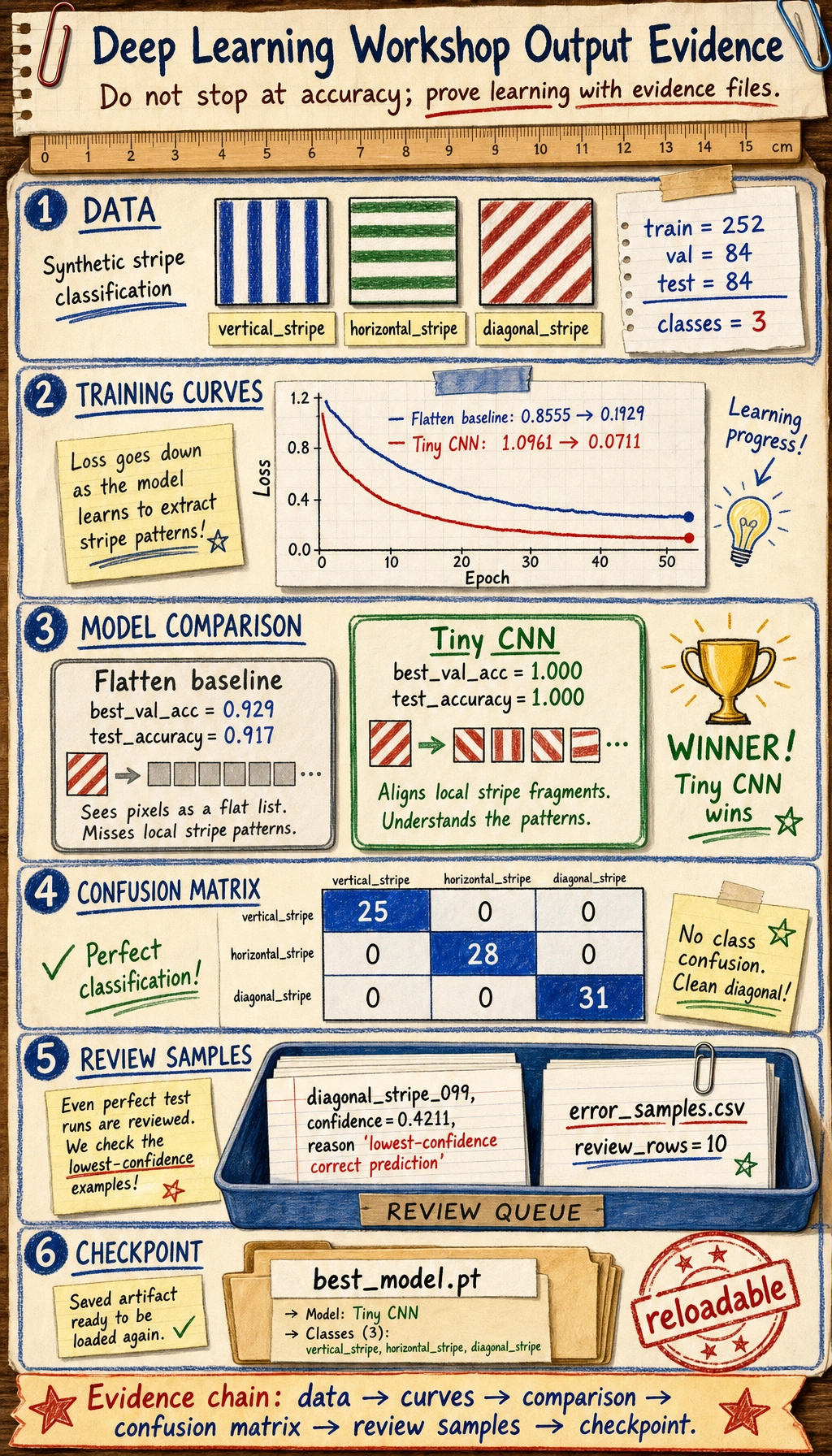
Start with shape_trace.md
Run:
sed -n '1,20p' deep_learning_workshop_run/reports/shape_trace.md
Expected output:
# Shape Trace

- One image batch: `(32, 1, 16, 16)` means batch, channel, height, width.
- One label batch: `(32,)` means one class id per image.
- Model output should be `(batch, 3)`, one logit per class.
Read it as:
32: batch size1: grayscale channel16: image height16: image width
If this shape does not match what Conv2d expects, training will fail before the model can learn anything.
Read training_log.csv
Run a tiny reader instead of trying to inspect the whole CSV by eye:
python - <<'PY'
import csv
from collections import defaultdict
from pathlib import Path

rows = list(csv.DictReader((Path("deep_learning_workshop_run") / "outputs" / "training_log.csv").open()))
by_model = defaultdict(list)
for row in rows:
    by_model[row["model"]].append(row)

for model, model_rows in by_model.items():
    first = model_rows[0]
    last = model_rows[-1]
    print(
        f"{model}: "
        f"first_train_loss={float(first['train_loss']):.4f}, "
        f"last_train_loss={float(last['train_loss']):.4f}, "
        f"last_val_acc={float(last['val_acc']):.4f}"
    )
PY
Expected output:
Flatten baseline: first_train_loss=0.8555, last_train_loss=0.1929, last_val_acc=0.9286
Tiny CNN: first_train_loss=1.0961, last_train_loss=0.0711, last_val_acc=1.0000
Look for three things:
- Does
train_lossgo down? - Does
val_lossalso go down? - Does
val_accimprove without a large train/validation gap?
These questions are more useful than asking only whether the final accuracy is high.
Compare baseline and CNN
Run:
python - <<'PY'
import csv
import json
from pathlib import Path

run = Path("deep_learning_workshop_run")
summary = json.loads((run / "outputs" / "metrics_summary.json").read_text())
print(f"best_model={summary['best_model']}")
print(f"test_accuracy={summary['test_accuracy']:.3f}")

with (run / "outputs" / "model_comparison.csv").open() as file:
    for row in csv.DictReader(file):
        print(
            f"{row['model']}: "
            f"best_val_acc={float(row['best_val_acc']):.3f}, "
            f"test_accuracy={float(row['test_accuracy']):.3f}"
        )
PY
Expected output:
best_model=Tiny CNN
test_accuracy=1.000
Tiny CNN: best_val_acc=1.000, test_accuracy=1.000
Flatten baseline: best_val_acc=0.929, test_accuracy=0.917
The Flatten baseline ignores the idea of local visual patterns. The Tiny CNN can learn small local kernels, so it is a better match for stripe-like image data. This is the practical meaning of “choose a model structure that matches the data structure.”
Review error_samples.csv
First read the confusion matrix:
cat deep_learning_workshop_run/outputs/confusion_matrix.csv
Expected output:
actual/predicted,vertical_stripe,horizontal_stripe,diagonal_stripe
vertical_stripe,25,0,0
horizontal_stripe,0,28,0
diagonal_stripe,0,0,31
Then inspect the review sample file:
python - <<'PY'
import csv
from pathlib import Path

rows = list(csv.DictReader((Path("deep_learning_workshop_run") / "outputs" / "error_samples.csv").open()))
print(f"review_rows={len(rows)}")
first = rows[0]
print(
    f"first_review={first['sample_id']} "
    f"predicted={first['predicted']} "
    f"confidence={float(first['confidence']):.4f} "
    f"reason={first['review_reason']}"
)
PY
Expected output:
review_rows=10
first_review=diagonal_stripe_099 predicted=diagonal_stripe confidence=0.4211 reason=lowest-confidence correct prediction
If the model makes mistakes, this file stores wrong predictions. If the model gets all test samples correct, it stores the lowest-confidence correct predictions instead. Both are useful: real projects need review samples, not only a final score.
Look at the loss curve
Open deep_learning_workshop_run/curves/loss_curve.png.
Ask:
- Are training and validation moving in the same direction?
- Does one model converge faster?
- Does validation stop improving while training keeps improving?
This is the habit you will reuse in transfer learning, fine-tuning, and large model training.
Load the Checkpoint Once
A checkpoint is useful only if it can be loaded. Run a quick smoke test:
python - <<'PY'
from pathlib import Path
import torch

checkpoint = torch.load(Path("deep_learning_workshop_run") / "checkpoints" / "best_model.pt", map_location="cpu")
print(checkpoint["model_name"])
print(", ".join(checkpoint["classes"]))
PY
Expected output:
Tiny CNN
vertical_stripe, horizontal_stripe, diagonal_stripe
This does not rebuild the model yet. It simply proves the file contains the model name, saved parameters, and class list needed for a future inference script.
Common Errors and Debugging Loop
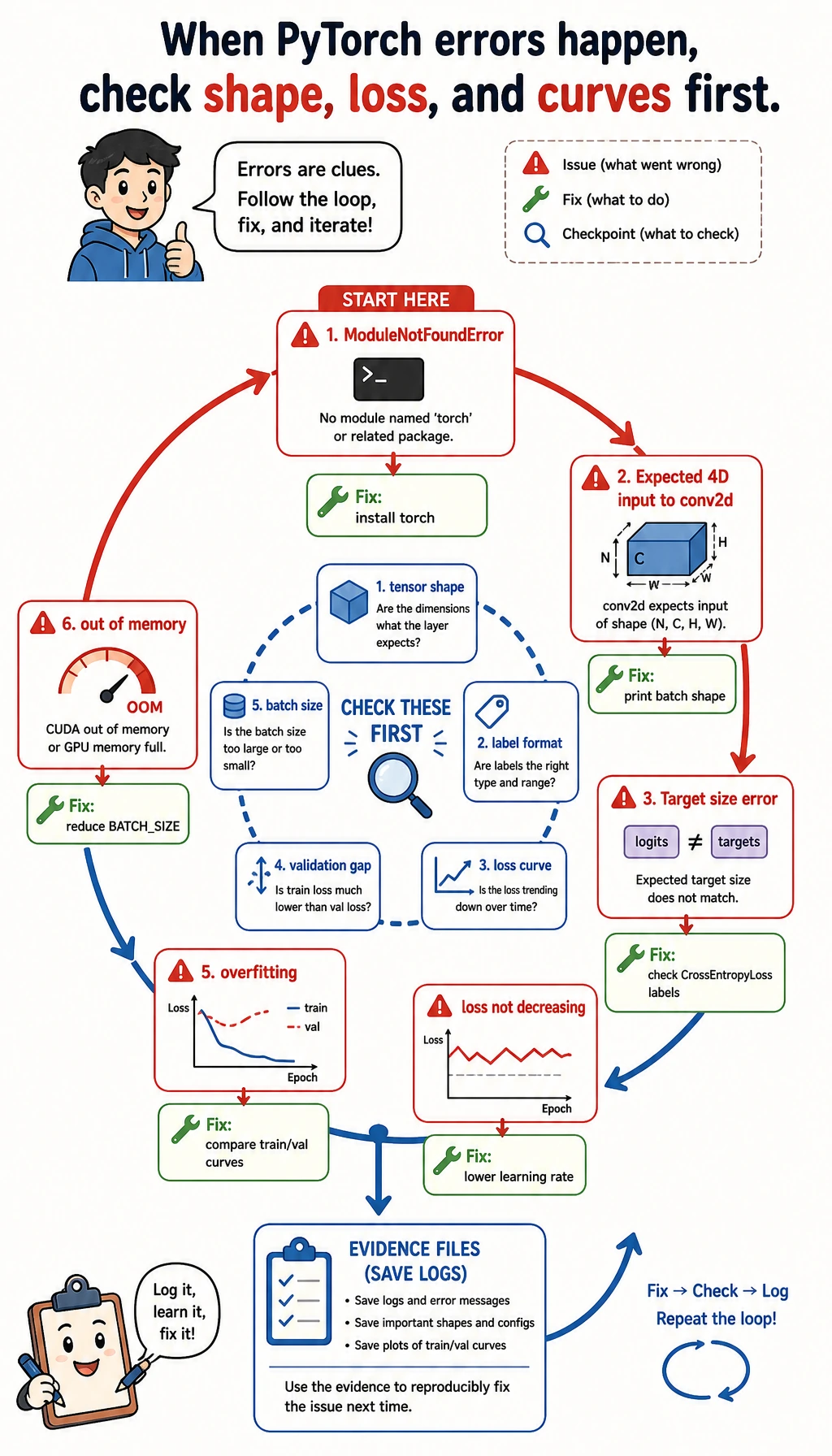
| Symptom | Likely cause | What to do |
|---|---|---|
ModuleNotFoundError: No module named 'torch' | PyTorch is not installed in the active environment | Run python -m pip install torch matplotlib |
Expected 4D input to conv2d | Image tensor is missing channel or batch dimension | Print the batch shape and make sure it is (batch, channel, height, width) |
Target size or class index error | Labels do not match CrossEntropyLoss expectations | Use integer class ids with shape (batch,) |
| Loss does not decrease | Learning rate is wrong, labels are wrong, or inputs are badly scaled | Try a smaller learning rate and overfit a tiny batch |
| Training improves but validation does not | Overfitting or bad split | Add regularization, more data, augmentation, or early stopping |
| CPU/GPU memory issue | Batch, image, or model is too large | Reduce BATCH_SIZE, image size, or model width first |
Turn This Into a Portfolio Project
Upgrade the workshop in small steps:
- Replace the synthetic stripe dataset with a small folder of real images.
- Add
config.jsonforbatch_size,learning_rate,epochs, and model name. - Add data augmentation after you have a stable baseline.
- Save a grid of review samples instead of only a CSV.
- Add early stopping and explain why the chosen epoch is best.
- Write a README paragraph explaining the top failure patterns.
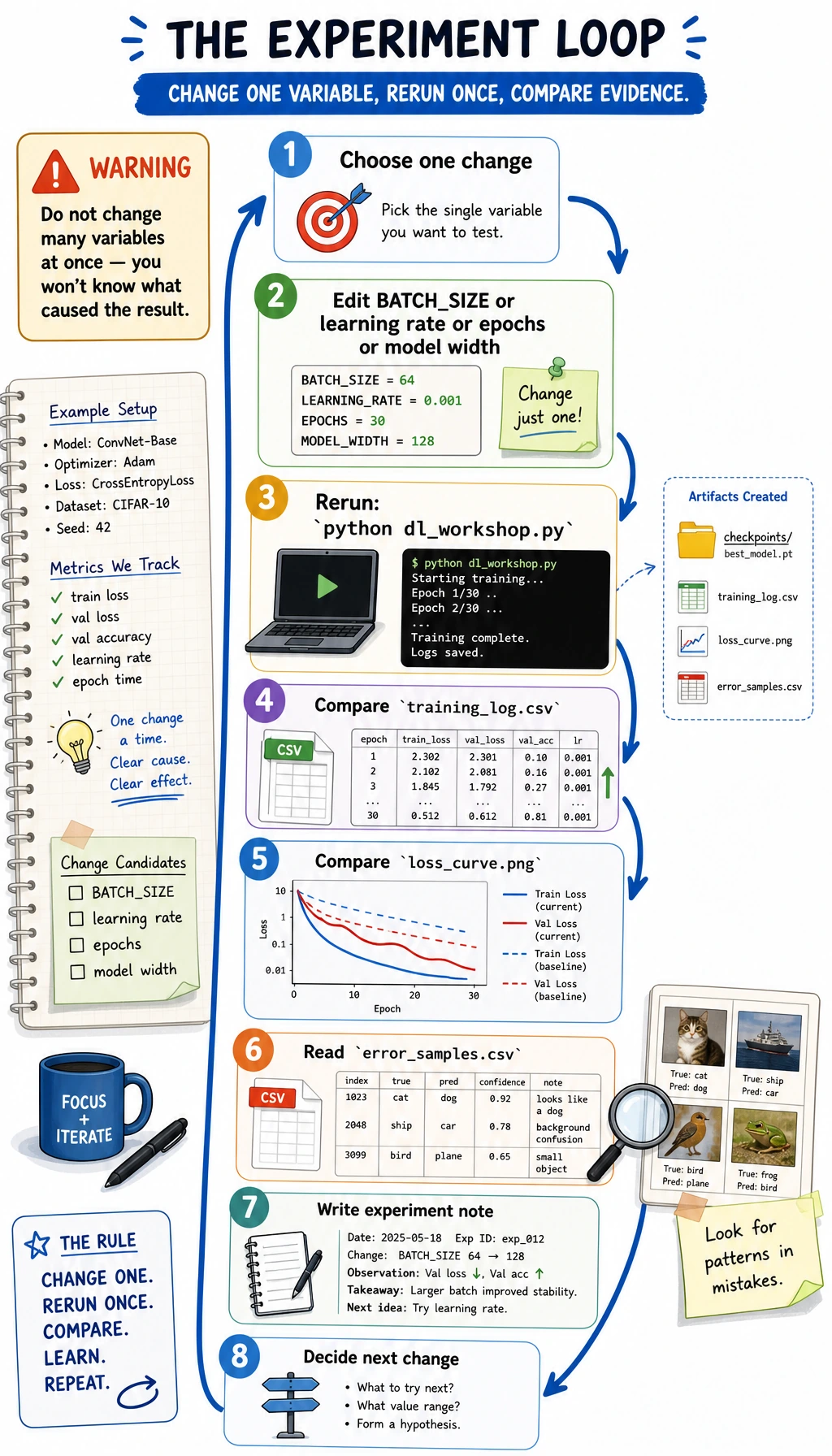
Practice a One-Variable Rerun
Do one small experiment before you move on:
- Keep a copy of the first run's
training_log.csvandloss_curve.png. - Change only one constant in
dl_workshop.py, such asBATCH_SIZE, the CNN learning rate, or the CNN epoch count. - Run
python dl_workshop.pyagain. - Compare the new
training_log.csv,model_comparison.csv,loss_curve.png, anderror_samples.csv.
Add a short experiment note:
python - <<'PY'
from pathlib import Path

run = Path("deep_learning_workshop_run")
note = run / "reports" / "experiment_notes.md"
note.write_text(
    "\n".join(
        [
            "# Experiment Notes",
            "",
            "- Run 1: default constants, Tiny CNN selected by validation accuracy.",
            "- Next change: adjust only `BATCH_SIZE` or only `lr`, then compare `training_log.csv` and `loss_curve.png`.",
        ]
    )
    + "\n",
    encoding="utf-8",
)
print(note)
PY
Expected output:
deep_learning_workshop_run/reports/experiment_notes.md
The important habit is not getting a better score every time. It is changing one variable, rerunning cleanly, and explaining the result with evidence.
Portfolio Checklist
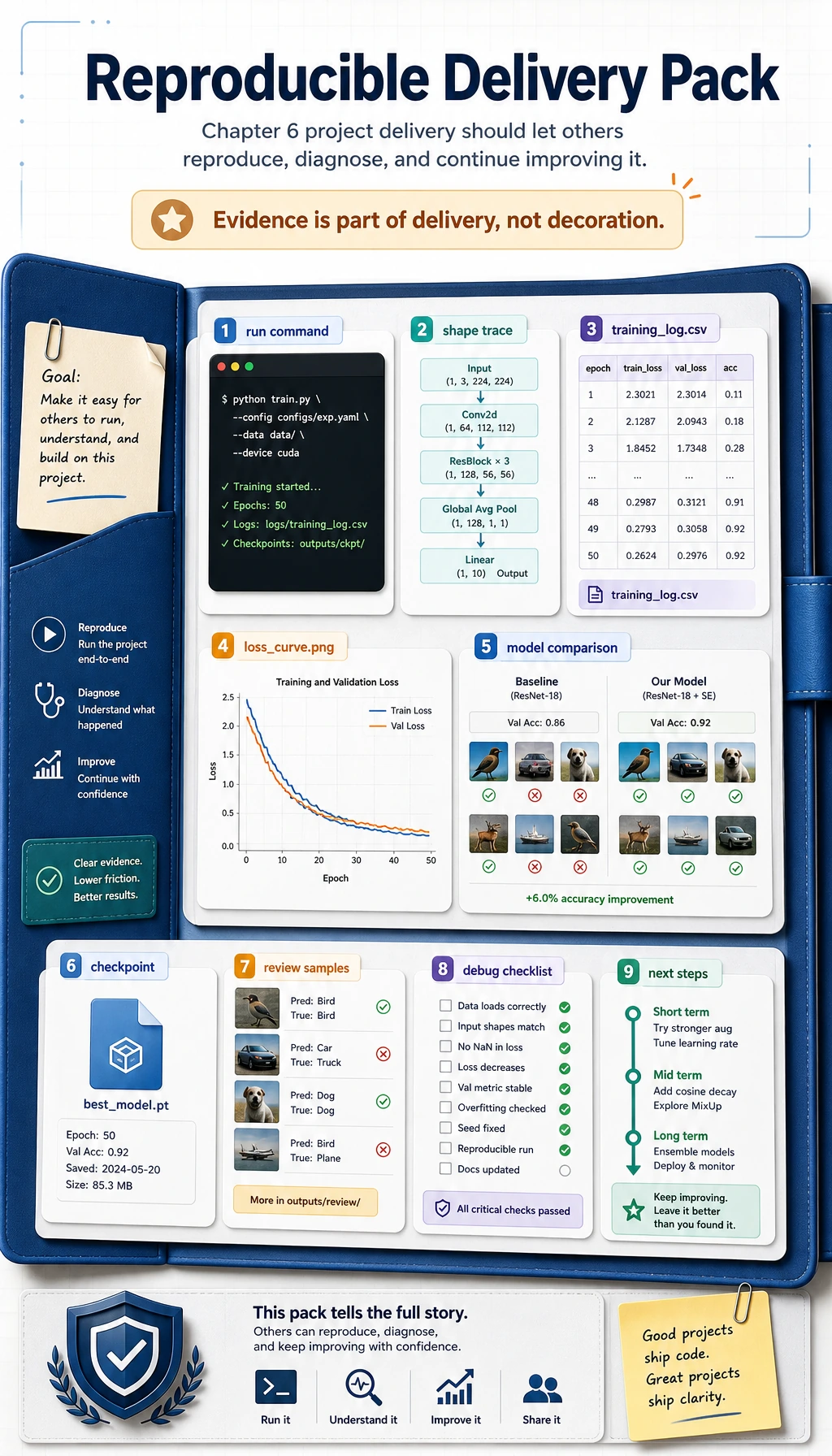
Before calling a Chapter 6 project done, make sure you have:
- A run command that works from a clean folder
- A tensor shape trace
- A baseline model
- An improved model
- Training and validation logs
- A loss curve
- A model comparison table
- A checkpoint
- Review samples or failed samples
- A README with limitations and next steps
Summary
This workshop turns Chapter 6 into one runnable loop: tensors, dataset, dataloader, model, loss, optimizer, training, validation, checkpoint, curves, review samples, and README evidence. If you can rerun it and explain each output file, you are practicing deep learning as an engineering workflow, not only copying PyTorch code.