2.3.5 Follow-Along Workshop: Build a Local Learning Task Assistant
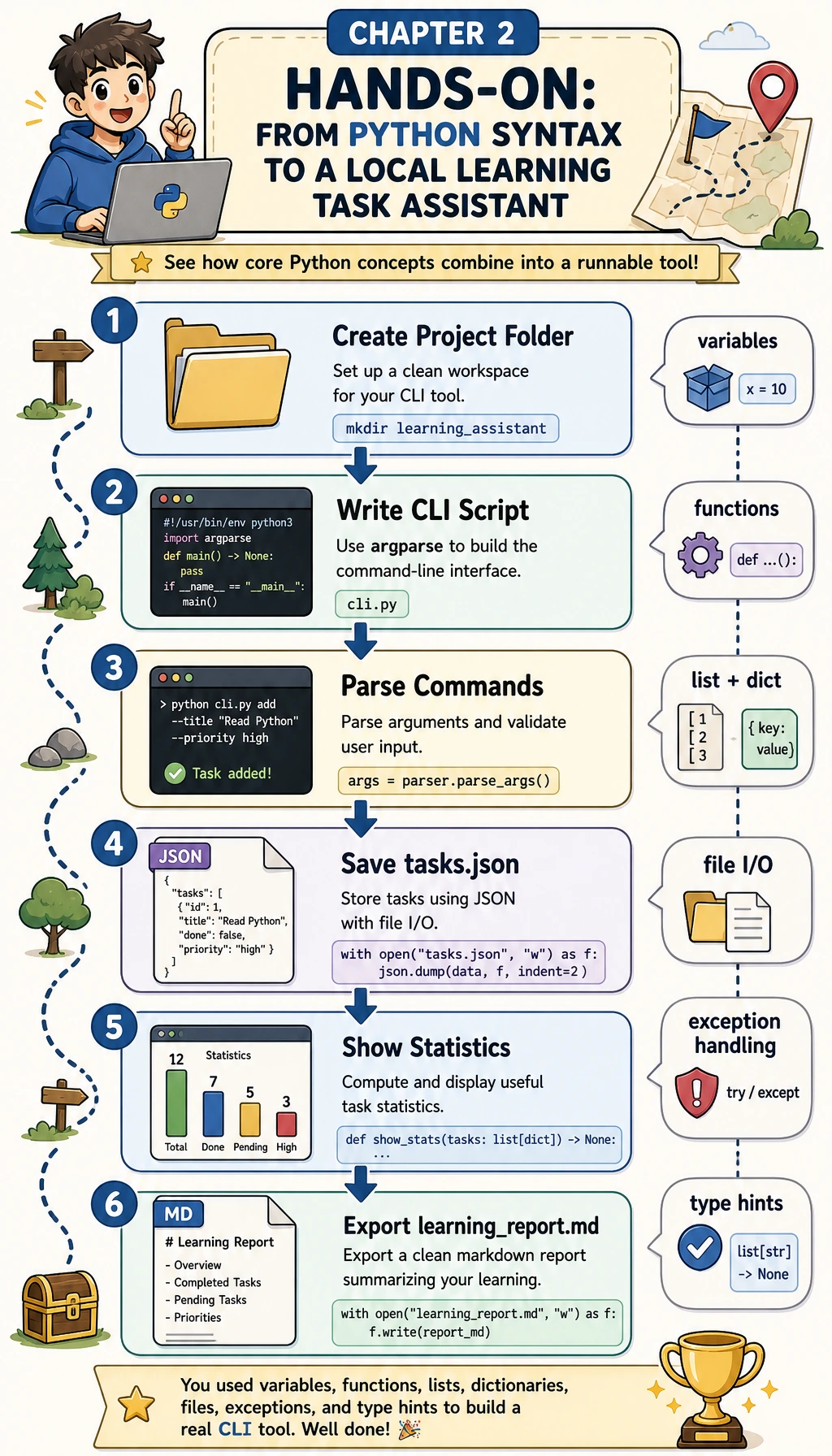
This page is the practical bridge for Chapter 2. You will not just read syntax explanations; you will build a small tool that can create learning tasks, save them to JSON, mark tasks as done, show statistics, and export a Markdown report.
What you will build
You will build a command-line learning task assistant named learning_assistant_cli.py. It uses only the Python standard library, so you do not need to install third-party packages.
After following the steps, you will be able to run commands like:
python3 learning_assistant_cli.py seed
python3 learning_assistant_cli.py list
python3 learning_assistant_cli.py add "Practice command-line arguments" --stage 2.3 --tag argparse
python3 learning_assistant_cli.py done 2
python3 learning_assistant_cli.py stats
python3 learning_assistant_cli.py export
The project will create:
| File | Purpose |
|---|---|
learning_assistant_cli.py | The runnable Python program |
ch02_output/tasks.json | Saved learning tasks |
ch02_output/learning_report.md | Exported portfolio evidence |
Step 0: Create a clean practice folder
Run these commands in a terminal:
mkdir ch02-learning-assistant-workshop
cd ch02-learning-assistant-workshop
python3 --version
Expected output looks like this. The exact version number can be different.
Python 3.12.3
This workshop uses modern Python standard-library features such as dataclass, list[str], and str | None. Use Python 3.10 or newer.
Step 1: See the whole program before typing
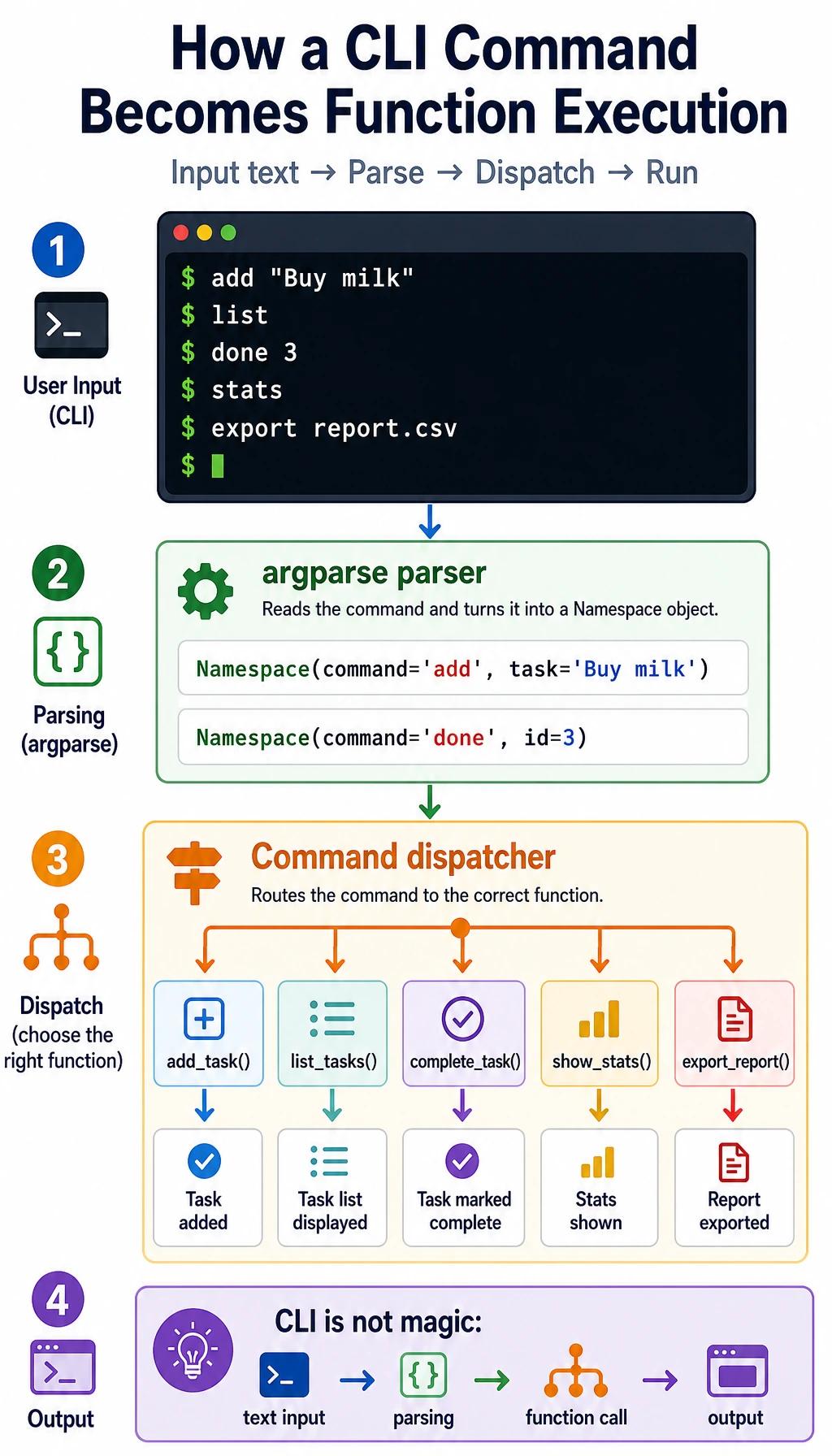
The program follows one simple route:
| Step | What happens | Python concept |
|---|---|---|
| User types a command | add, list, done, stats, or export | command-line arguments |
argparse parses it | The command becomes structured data | functions and modules |
| The program loads JSON | Existing tasks are read from disk | file I/O and exceptions |
| A command function runs | Data is changed or summarized | lists, dictionaries, loops |
| The program saves output | JSON or Markdown is written back | persistence |
Keep this picture in mind while reading the code. You are building a small but complete program, not just practicing isolated syntax.
Step 2: Create the full script
Create a file named learning_assistant_cli.py, then paste the code below.
from __future__ import annotations

import argparse
import json
from dataclasses import asdict, dataclass, field
from datetime import datetime, timezone
from pathlib import Path

OUTPUT_DIR = Path("ch02_output")
DATA_FILE = OUTPUT_DIR / "tasks.json"
REPORT_FILE = OUTPUT_DIR / "learning_report.md"


def utc_now() -> str:
    return datetime.now(timezone.utc).replace(microsecond=0).isoformat()


@dataclass
class Task:
    id: int
    title: str
    stage: str
    tags: list[str]
    done: bool = False
    created_at: str = field(default_factory=utc_now)
    completed_at: str | None = None


def ensure_output_dir() -> None:
    OUTPUT_DIR.mkdir(exist_ok=True)


def load_tasks() -> list[Task]:
    if not DATA_FILE.exists():
        return []
    try:
        raw_tasks = json.loads(DATA_FILE.read_text(encoding="utf-8"))
    except json.JSONDecodeError as exc:
        raise SystemExit(f"Cannot read {DATA_FILE}: invalid JSON at line {exc.lineno}. Fix or remove the file, then rerun.") from exc
    return [Task(**item) for item in raw_tasks]


def save_tasks(tasks: list[Task]) -> None:
    ensure_output_dir()
    data = [asdict(task) for task in tasks]
    DATA_FILE.write_text(json.dumps(data, ensure_ascii=False, indent=2), encoding="utf-8")


def next_id(tasks: list[Task]) -> int:
    if not tasks:
        return 1
    return max(task.id for task in tasks) + 1


def seed_tasks(_: argparse.Namespace) -> None:
    tasks = [
        Task(id=1, title="Read Python functions", stage="2.1", tags=["functions"]),
        Task(id=2, title="Practice JSON file saving", stage="2.2", tags=["json", "file-io"]),
        Task(id=3, title="Build the first CLI command", stage="2.3", tags=["cli"]),
    ]
    save_tasks(tasks)
    print(f"Wrote {len(tasks)} sample tasks to {DATA_FILE}")


def add_task(args: argparse.Namespace) -> None:
    title = args.title.strip()
    if not title:
        raise SystemExit("Task title cannot be empty.")
    tasks = load_tasks()
    task = Task(id=next_id(tasks), title=title, stage=args.stage, tags=args.tag)
    tasks.append(task)
    save_tasks(tasks)
    print(f"Added task #{task.id}: {task.title}")


def list_tasks(_: argparse.Namespace) -> None:
    tasks = load_tasks()
    if not tasks:
        print("No tasks yet. Run: python learning_assistant_cli.py add \"Read functions\"")
        return
    print("ID  Status  Stage  Title")
    print("--  ------  -----  -----")
    for task in tasks:
        status = "done" if task.done else "todo"
        print(f"{task.id:<2}  {status:<6}  {task.stage:<5}  {task.title}")


def complete_task(args: argparse.Namespace) -> None:
    tasks = load_tasks()
    for task in tasks:
        if task.id == args.id:
            task.done = True
            task.completed_at = utc_now()
            save_tasks(tasks)
            print(f"Completed task #{task.id}: {task.title}")
            return
    raise SystemExit(f"Task #{args.id} was not found.")


def show_stats(_: argparse.Namespace) -> None:
    tasks = load_tasks()
    total = len(tasks)
    done = sum(task.done for task in tasks)
    todo = total - done
    by_stage: dict[str, int] = {}
    for task in tasks:
        by_stage[task.stage] = by_stage.get(task.stage, 0) + 1
    rate = (done / total * 100) if total else 0
    print(f"Total tasks: {total}")
    print(f"Done: {done}")
    print(f"Todo: {todo}")
    print(f"Completion rate: {rate:.1f}%")
    print("Tasks by stage:")
    for stage, count in sorted(by_stage.items()):
        print(f"- {stage}: {count}")


def export_report(_: argparse.Namespace) -> None:
    tasks = load_tasks()
    done = sum(task.done for task in tasks)
    total = len(tasks)
    lines = [
        "# Python Learning Assistant Report",
        "",
        f"Generated at: {utc_now()}",
        f"Total tasks: {total}",
        f"Completed tasks: {done}",
        "",
        "## Tasks",
        "",
    ]
    for task in tasks:
        checkbox = "x" if task.done else " "
        tags = ", ".join(task.tags) if task.tags else "-"
        lines.append(f"- [{checkbox}] #{task.id} {task.title} (stage {task.stage}; tags: {tags})")
    ensure_output_dir()
    REPORT_FILE.write_text("\n".join(lines) + "\n", encoding="utf-8")
    print(f"Exported report to {REPORT_FILE}")


def build_parser() -> argparse.ArgumentParser:
    parser = argparse.ArgumentParser(description="Local learning-task assistant for Chapter 2 Python practice.")
    subparsers = parser.add_subparsers(dest="command", required=True)

    seed_parser = subparsers.add_parser("seed", help="Create sample tasks.")
    seed_parser.set_defaults(func=seed_tasks)

    add_parser = subparsers.add_parser("add", help="Add one learning task.")
    add_parser.add_argument("title", help="Task title, wrapped in quotes if it contains spaces.")
    add_parser.add_argument("--stage", default="2.1", help="Course stage or section, such as 2.1 or 2.3.")
    add_parser.add_argument("--tag", action="append", default=[], help="Repeatable tag, such as --tag functions --tag json.")
    add_parser.set_defaults(func=add_task)

    list_parser = subparsers.add_parser("list", help="List tasks.")
    list_parser.set_defaults(func=list_tasks)

    done_parser = subparsers.add_parser("done", help="Mark one task as complete.")
    done_parser.add_argument("id", type=int, help="Task id to complete.")
    done_parser.set_defaults(func=complete_task)

    stats_parser = subparsers.add_parser("stats", help="Show task statistics.")
    stats_parser.set_defaults(func=show_stats)

    export_parser = subparsers.add_parser("export", help="Export a Markdown report.")
    export_parser.set_defaults(func=export_report)
    return parser


def main() -> None:
    parser = build_parser()
    args = parser.parse_args()
    args.func(args)


if __name__ == "__main__":
    main()
Step 3: Run the first command
python3 learning_assistant_cli.py seed
Expected output:
Wrote 3 sample tasks to ch02_output/tasks.json
Now list the tasks:
python3 learning_assistant_cli.py list
Expected output:
ID  Status  Stage  Title
--  ------  -----  -----
1   todo    2.1    Read Python functions
2   todo    2.2    Practice JSON file saving
3   todo    2.3    Build the first CLI command
Step 4: Add and complete a task
Add a new task:
python3 learning_assistant_cli.py add "Practice command-line arguments" --stage 2.3 --tag argparse
Expected output:
Added task #4: Practice command-line arguments
Mark task 2 as complete:
python3 learning_assistant_cli.py done 2
Expected output:
Completed task #2: Practice JSON file saving
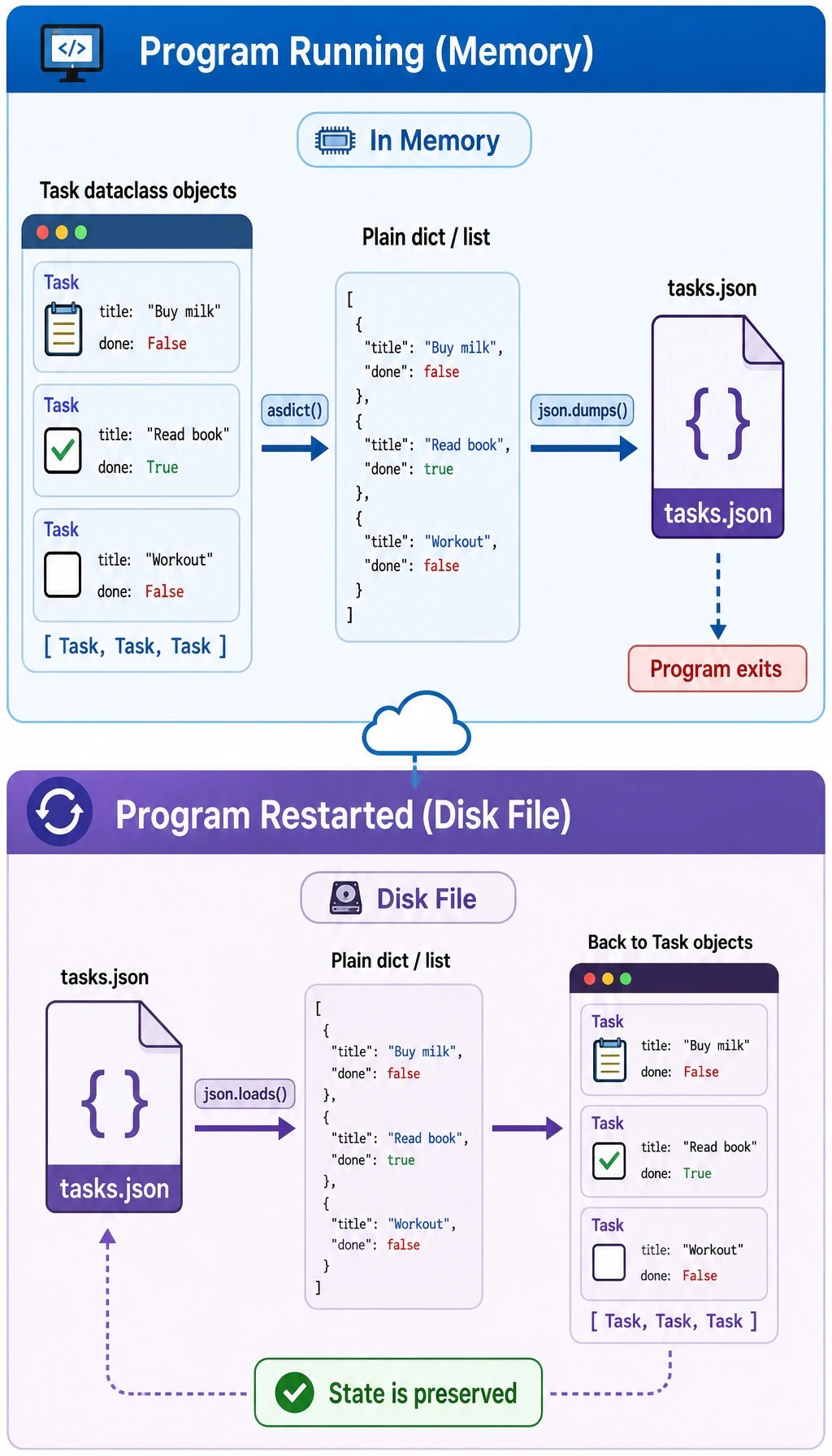
At this point, open ch02_output/tasks.json. You should see normal JSON data. The exact timestamps will be different, but the done field for task 2 should be true.
Step 5: Show statistics and export a report
python3 learning_assistant_cli.py stats
Expected output:
Total tasks: 4
Done: 1
Todo: 3
Completion rate: 25.0%
Tasks by stage:
- 2.1: 1
- 2.2: 1
- 2.3: 2
Export a Markdown report:
python3 learning_assistant_cli.py export
Expected output:
Exported report to ch02_output/learning_report.md
You now have a runnable project and a small report that can be used as portfolio evidence.
Step 6: Understand the important parts
| Code piece | What it teaches | Why it matters later |
|---|---|---|
argparse | Convert terminal commands into structured values | Every CLI, script, and automation tool needs clear inputs |
@dataclass | Describe one task with fields | Later API models, database rows, and config objects use the same idea |
load_tasks() | Read saved JSON and handle bad JSON | Real programs must survive missing or broken files |
save_tasks() | Convert Python objects into JSON | This is the minimum version of persistence |
| command functions | Keep each command in one function | Larger projects rely on clear function boundaries |
export_report() | Turn internal data into user-facing output | AI and data tools often need reports, logs, and evidence |
Common mistakes and fixes
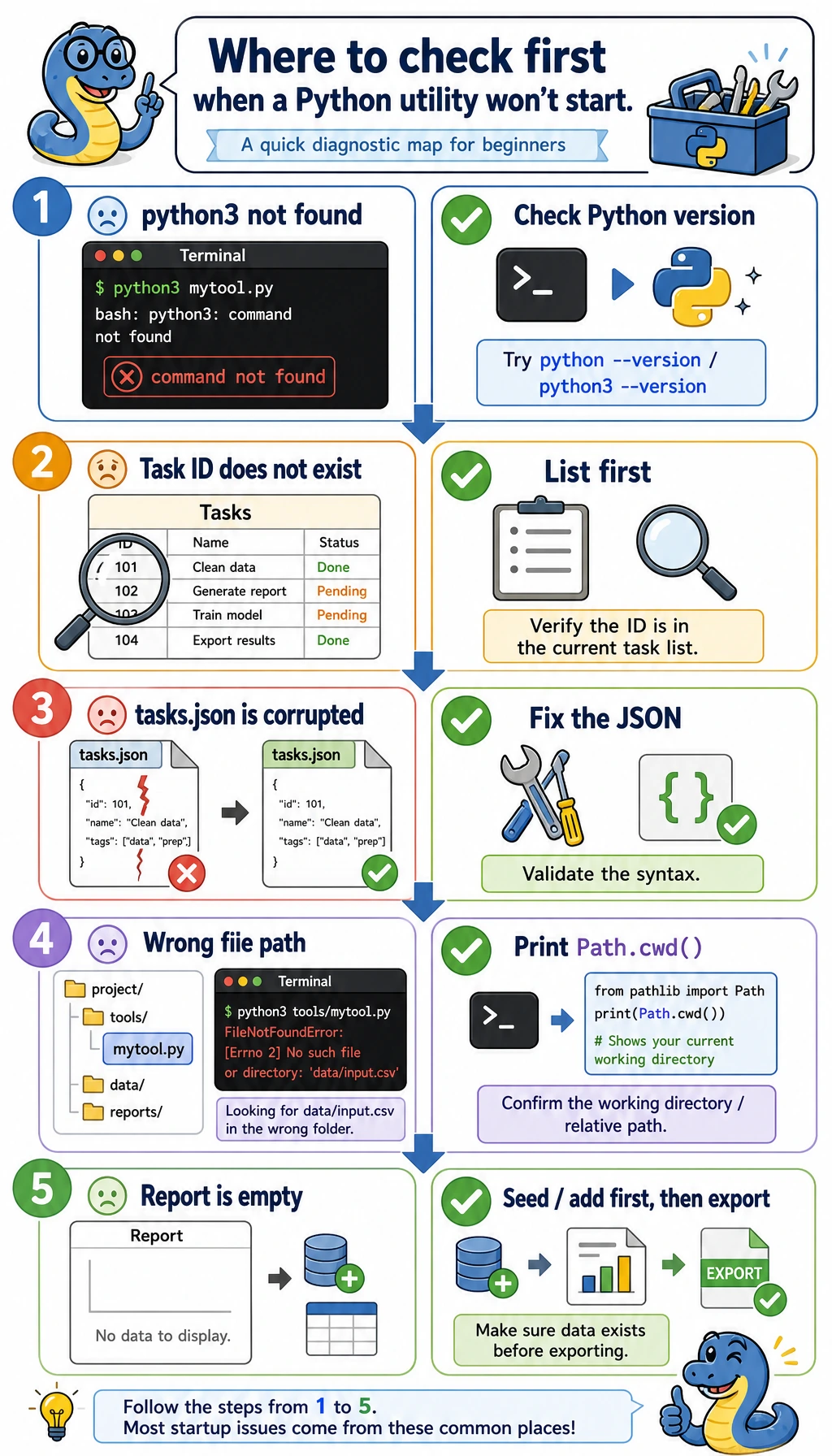
| Problem | Likely cause | Fix |
|---|---|---|
python3: command not found | Your system uses python instead of python3 | Try python --version, then run python learning_assistant_cli.py seed |
Task #99 was not found. | You tried to complete a task id that does not exist | Run python3 learning_assistant_cli.py list first |
invalid JSON error | tasks.json was edited manually and broken | Fix the JSON file or delete it and run seed again |
| The report is empty | No tasks were created yet | Run seed or add before export |
| You understand the code but cannot modify it | The whole script feels too large | Change only one command at a time, then rerun the matching command |
Mini exercises
- Add a
deletecommand that removes a task by id. - Add a
searchcommand that finds tasks containing a keyword. - Add a
--tagfilter tolist. - Change
export_report()to include unfinished tasks first. - Deliberately break
tasks.json, runlist, then write down the error message and your fix.
Portfolio evidence checklist
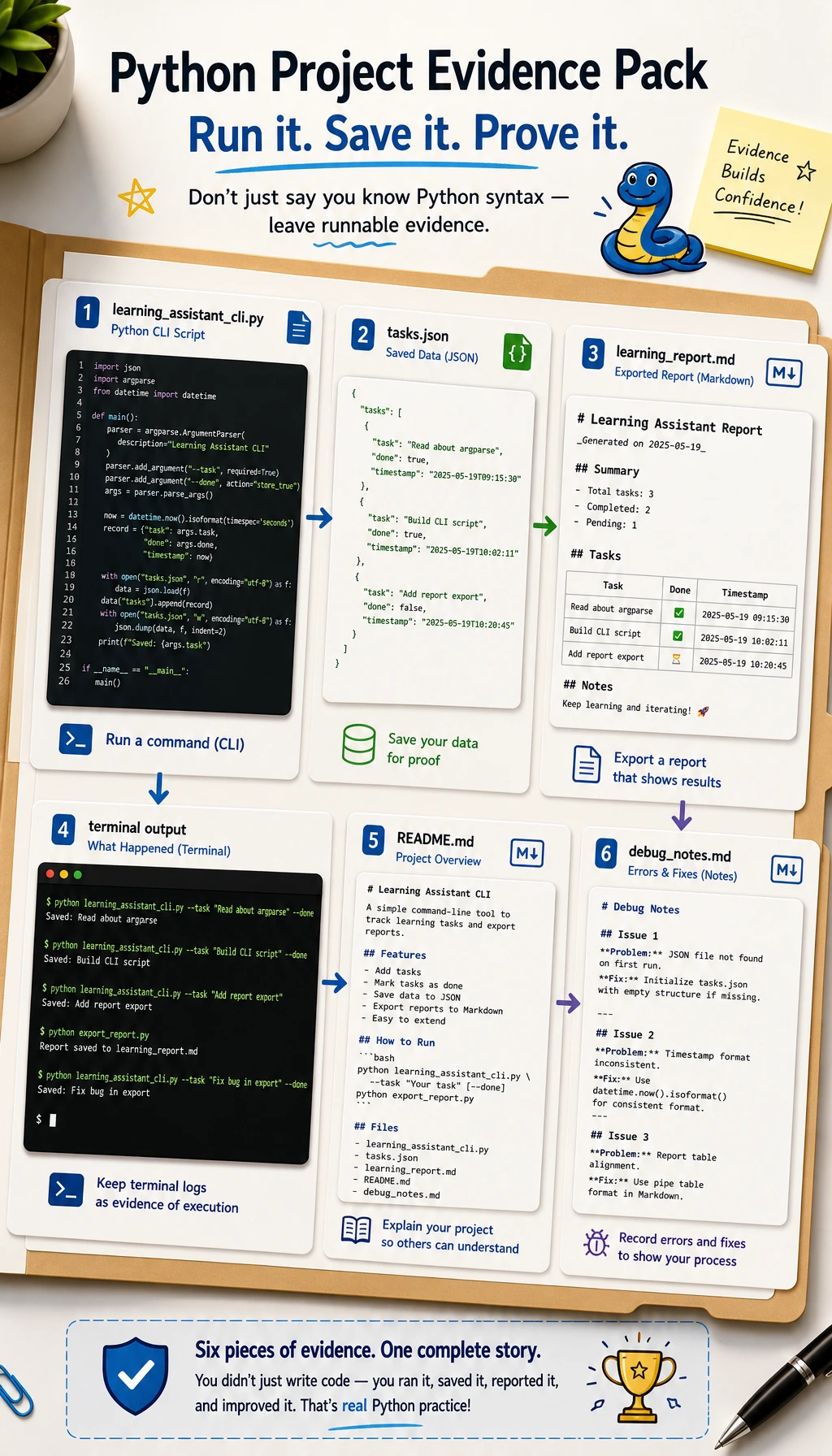
Keep these files as evidence:
learning_assistant_cli.pych02_output/tasks.jsonch02_output/learning_report.md- A screenshot or copied terminal output showing
seed,list,done,stats, andexport - A short
README.mdexplaining how to run the tool and what errors you handled
This is the core habit of Chapter 2: do not stop at syntax. Turn syntax into a small tool that runs, saves data, handles errors, and can be explained.